- Industrial animal farming causes systemic suffering
- The problems are built into the model itself
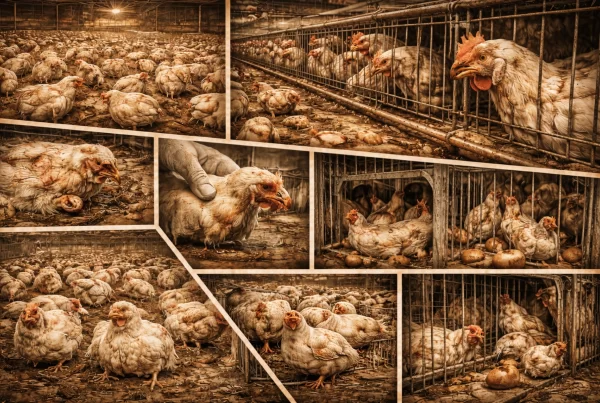
- Birds suffer from extreme growth and overcrowding
- Laying hens live under severe restriction
- Pigs endure confinement and painful procedures
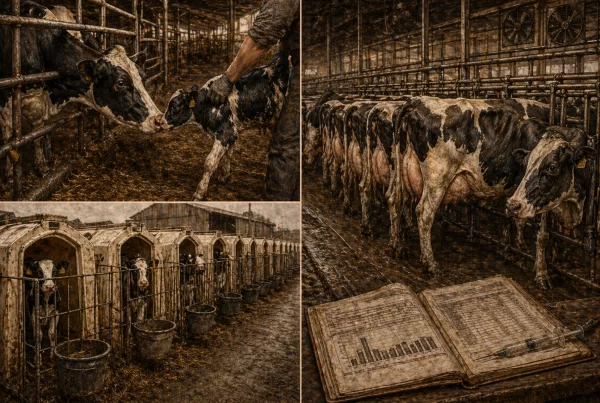
- Dairy cows are subjected to chronic metabolic stress
- Calves are separated from their mothers early
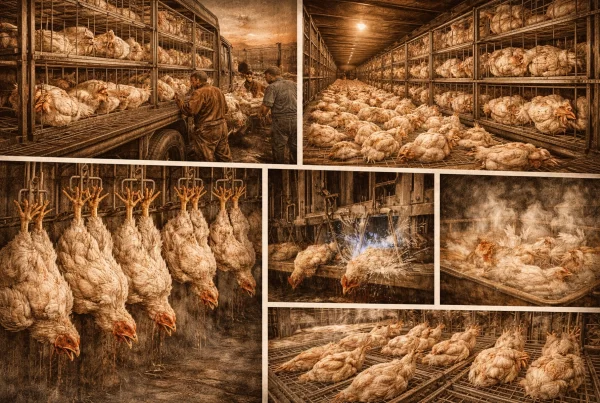
- Transport and slaughter add acute distress
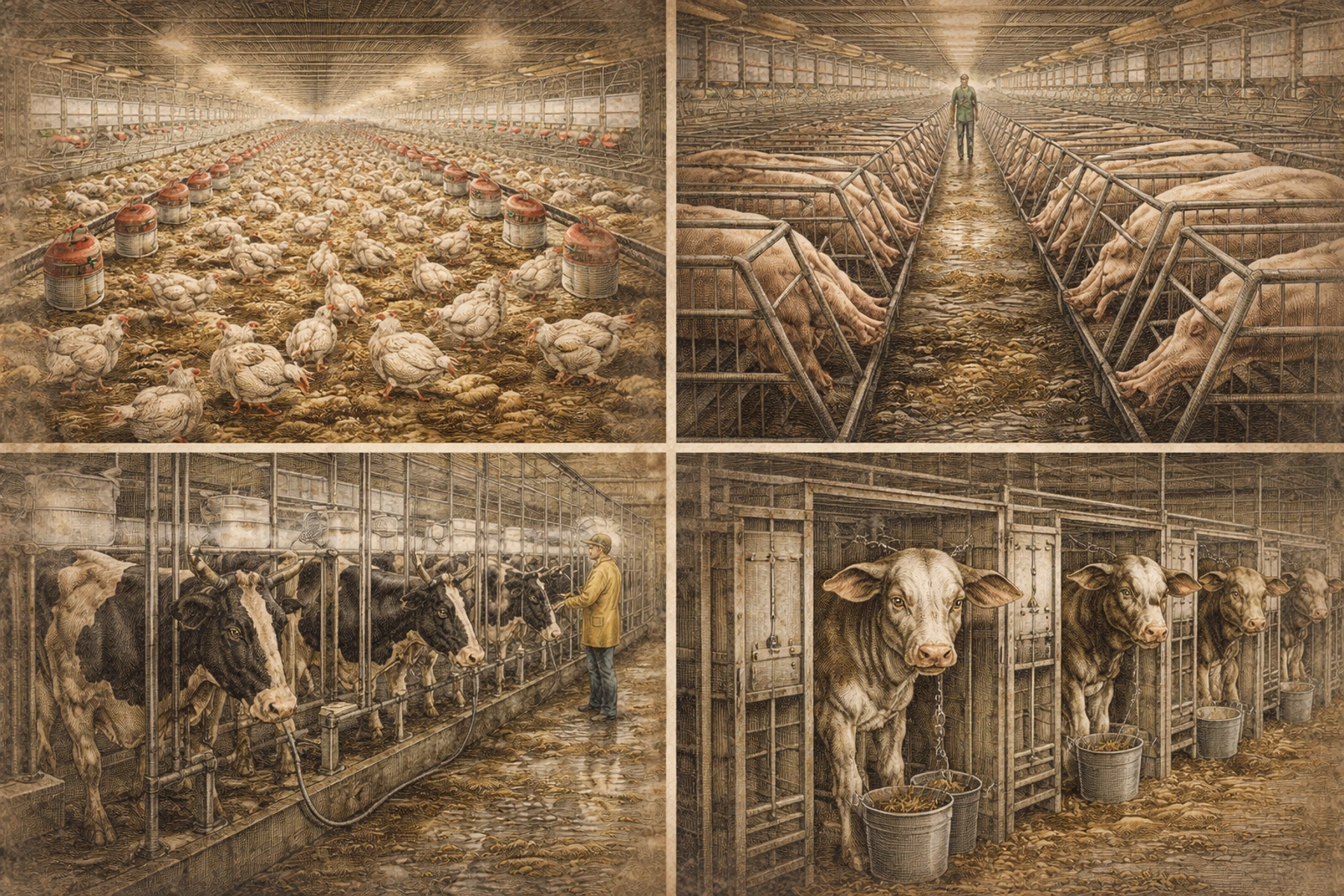
- Suffering is similar across different species
- Efficiency often comes at the expense of welfare
- The problem is structural, not accidental
- Humane alternatives require systemic change
Industrial animal farming is the backbone of modern food production, supplying most of the world’s meat, dairy products and eggs. And yet, behind the scale and efficiency of this system lies a reality that few consumers see and even fewer want to see: billions of animals living in confined, barren environments, unable to perform their natural behaviors, often experiencing chronic stress, pain or injury. Based on important reports by the Humane Society of the United States, Compassion in World Farming and the World Organisation for Animal Health, as well as scientific reviews, this article provides a cross-species overview of life in industrial farms.
The scale and logic of industrial farming
Industrial farming — also called “intensive” farming or “concentrated animal feeding” — is built around maximizing production while minimizing costs. Animals are bred for rapid growth or high output; this is done in high-density systems and through highly efficient production cycles.
Globally, in the United States alone, more than 11 billion animals are raised and slaughtered every year, with poultry making up ~86% of the total number. Industrial systems dominate because they produce food cheaply, but the effect on welfare — if it can be called that — is enormous.
Across different species, the following characteristics define industrial farming:
- Extreme restriction of space
- High stocking density
- Genetic selection for productivity
- Routine painful procedures
- Limited environmental enrichment
- Stressful handling, transport and slaughter
- Minimal legal protection on farms
These systemic characteristics are not accidental; they are built into the design of industrial farming. That is why welfare problems are widespread and predictable across all animals.
Poultry: Life for broilers and laying hens
Birds represent the largest number of farmed animals on Earth. Industrial poultry systems rely heavily on confinement and genetic optimization.
Broilers (birds raised for meat)
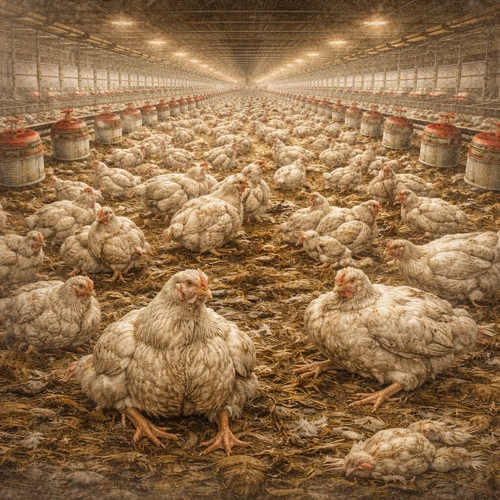
Broilers are usually raised in large windowless barns containing tens of thousands of birds. In other words, the feeling is like being in a chalga club during prom season, but without the alcohol and napkins. HSUS reports:
- Fast-growing genetics cause chronic pain, lameness and skeletal stress.
- ~26–30% suffer from severe gait problems.
- Birds live only 5–7 weeks before slaughter.
- Overcrowded conditions offer little space for movement or natural behaviors such as perching or dust bathing.
Lighting, ventilation and flooring are designed for productivity, not welfare. Birds often struggle to stand because their muscles are too large compared with their underdeveloped bones.
Laying hens (egg production)
The most controversial system is the battery cage, which confines hens in spaces too small for them to spread their wings.
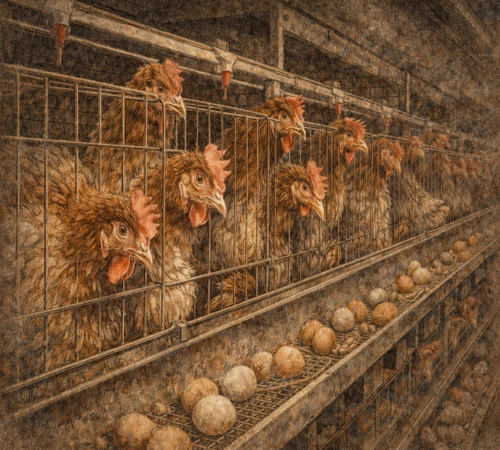
- 340 million hens are kept in cages in the United States alone.
- There are no perches, nesting boxes or opportunities for dust bathing.
- Severe feather loss and fragile bones occur due to lack of movement.
- Male chicks, useless to the egg industry, are killed in hatcheries — hundreds of millions every year.
CIWF calls cages one of the most severe forms of confinement in modern farming. WOAH recognizes the behavioral deprivation they impose.
Pigs: Confinement and mutilation
Industrial pork production often relies on severe confinement and invasive procedures.
Mothers during pregnancy and farrowing
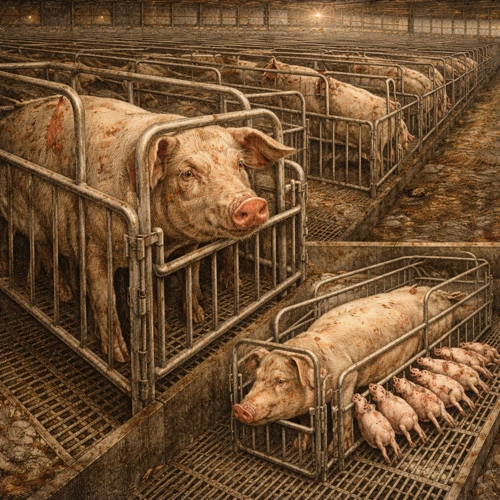
Mother pigs — highly intelligent animals — are confined for months in crates so narrow they cannot turn around. The welfare consequences, however inappropriate that word may feel here, include:
- Chronic stress and frustration
- Stereotypic behavior such as bar biting and sham chewing
- Pressure sores and injuries
- Lack of maternal behavior, such as nest building
Piglets are often born in farrowing crates, which similarly completely restrict the animal.
Mutilation of piglets
Routine procedures include:
- Tail docking
- Castration
- Tooth clipping
They are often performed without anesthesia, even though they cause acute and chronic pain.
Pigs in overcrowded indoor systems also experience aggression, respiratory problems and environmental deprivation — with little or no access to straw or materials for even minimal comfort, which are essential for their behavioral well-being.
Dairy cows and beef cattle: High productivity, terrible conditions
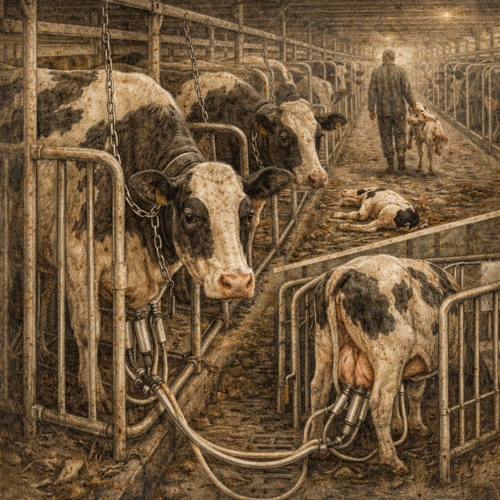
Dairy cows
Modern dairy cows are genetically selected for extremely high milk yield — often producing more than 10,000 liters per year. According to HSUS and CIWF:
- Cows are repeatedly impregnated in order to maintain lactation cycles.
- Calves are removed within hours after birth, causing distress to both animals.
- Housing often restricts movement, contributing to high levels of lameness, mastitis and metabolic disorders.
- The average cow is killed before the age of 5, despite a natural lifespan of 20+ years.
CIWF identifies zero-grazing systems and tethered housing as particularly harmful.
Beef cattle (feedlots)
Beef cattle often spend part of their lives on pasture, but the final phase often takes place in feedlots, with high stocking density, mud, heat stress and minimal shade. Transport to slaughterhouses can involve long distances without food or water.
Transport and slaughter: The final stress
Transport is stressful for all species:
- Long journeys without food or water
- Exposure to extreme heat or cold
- Overcrowding
- Rough handling
Slaughter systems, especially for birds, can routinely fail. HSUS reports that ~3% of birds may enter scalding tanks alive because of inadequate stunning — what a magical end to a wonderful life.
What different animal species have in common: System → Stress → Harm
In chickens, pigs and cows, the same farming pattern can be observed:
An industrial system that imposes behavioral restriction, leading to stress, pain, injury and chronic suffering.
This applies regardless of the animal species, because the design of the system — confinement, density, breeding and productivity pressure — determines welfare outcomes more than the management of individual farms.
Why this matters
The problems with raising and treating animals in industrial systems are not isolated incidents. They are structural features of a farming model that is strongly focused on efficiency.
Recognizing cross-species patterns is essential for:
- designing better welfare standards
- transitioning toward humane alternatives, if such alternatives exist
- informing consumers and policymakers
- grounding future reforms in scientific and ethical evidence
Industrial farming feeds billions of people — but it does so at the cost of enormous, predictable and often invisible suffering. This suffering can be reduced, and even disappear in a utopian future, if we as humanity embrace the idea that animals are not commodities, but conscious beings that are not so very different from ourselves.
Sources:
https://www.humanesociety.org/sites/default/files/docs/hsus-report-animal-welfare-industrial-agriculture.pdf
https://www.ciwf.org.uk/media/5235309/ciwf-strategic-plan.pdf
https://www.ciwf.org.uk/research/