- Poultry are the most numerous victims
- Broilers are selected for painful growth
- Laying hens live in severe behavioral deprivation
- Overcrowding and lack of environment are systemic
- Chronic pain is common in broilers
- Battery cages block natural behavior
- Male chicks are routinely destroyed
- Transport causes severe stress and injuries
- Slaughter often involves serious failures
- Birds have the weakest legal protection
- Their suffering is massive and largely hidden
- The problem lies in the industrial model itself
Poultry — mainly broilers, raised for meat, and laying hens, raised for eggs — make up the vast majority of animals in industrial agriculture. In the United States alone, more than 9 billion broilers and 340 million laying hens are raised every year. They are the least noticed, yet the most numerous victims of modern agriculture.
According to the Humane Society of the United States, broilers and laying hens experience some of the highest levels of deprivation, overcrowding and physical suffering among all farmed species. Similar conclusions have been reached by Compassion in World Farming and are consistent with scientific reviews of animal welfare.
This article provides a detailed look at what life is like for modern poultry — from birth, through the entire rearing period, all the way to transport and slaughter.
Broilers: Designed for extreme growth
Housing conditions
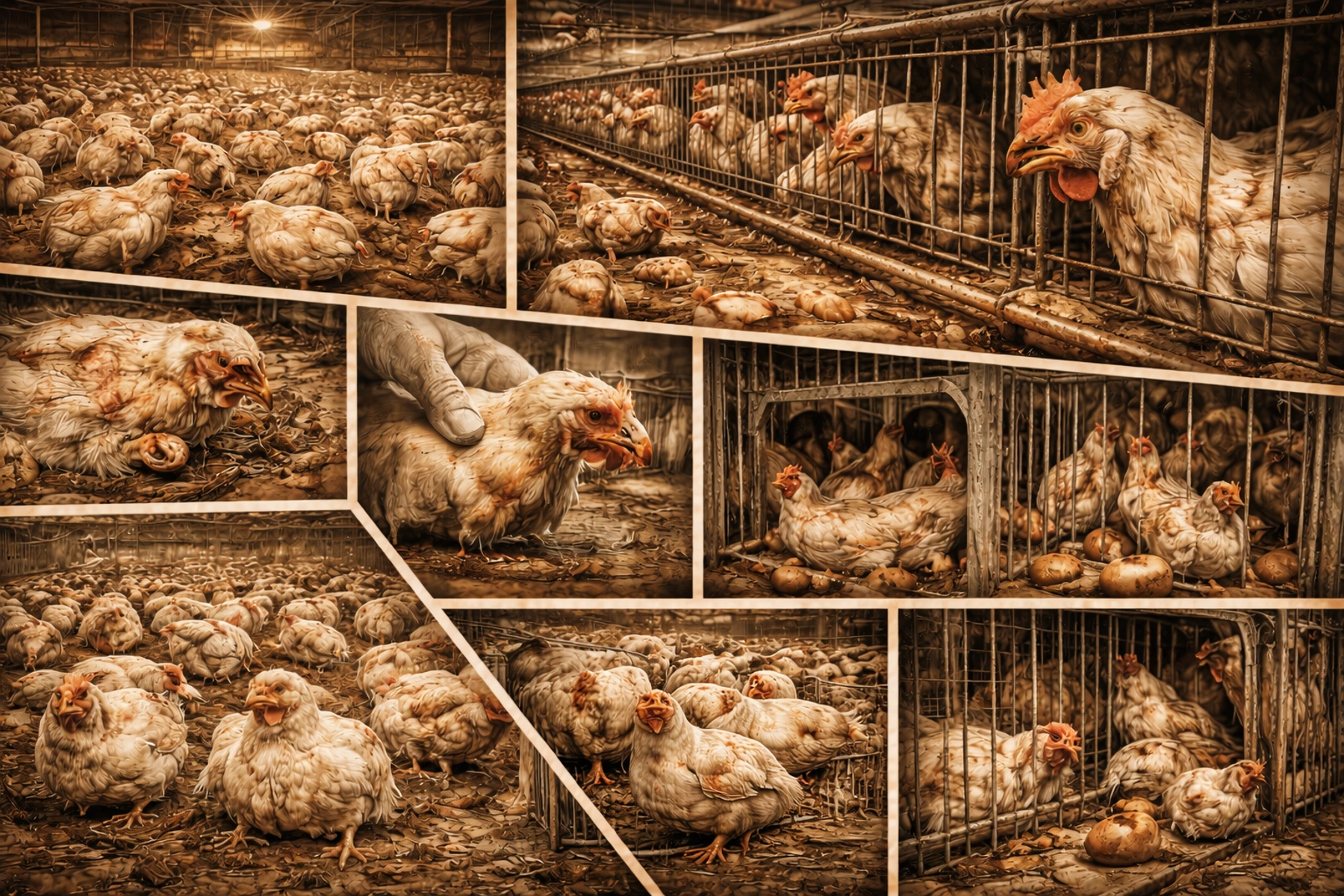
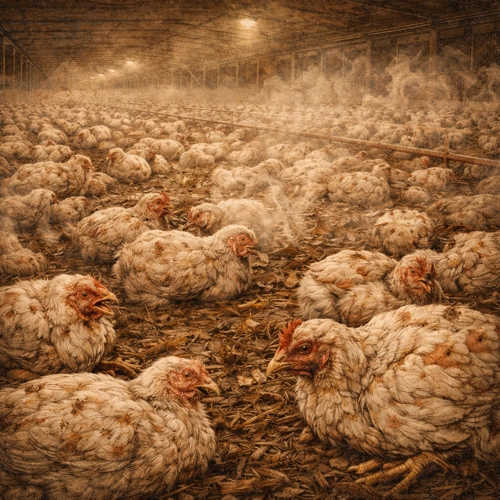
Commercial broilers are usually raised in large windowless sheds, housing 20,000–40,000 birds at the same time. These sheds are barren: no perches, no natural light, no environmental enrichment and minimal space per bird.
The flooring is usually litter, which becomes increasingly contaminated with manure as the birds grow. Poor air quality results from ammonia build-up, leading to:
- difficulty breathing
- eye irritation
- a higher risk of respiratory disease
Broilers rarely experience normal stimulation or comfort. Most spend their days sitting or lying in their own excrement.
Genetic selection and chronic pain
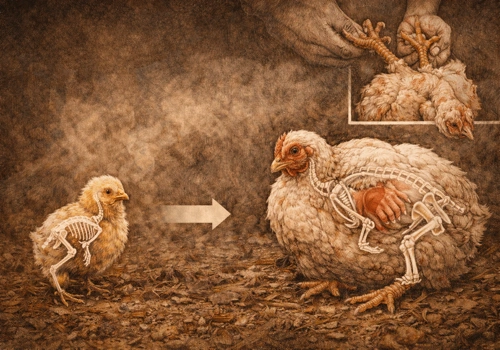
Modern broilers grow astronomically fast: from hatching to slaughter weight in only 5–7 weeks.
This is not natural growth — it is the result of decades of selective breeding for breast muscle mass and feed efficiency. HSUS and CIWF note serious welfare consequences:
- ~26–30% of broilers develop severe gait problems, often becoming unable to stand or walk.
- Bone development lags behind muscle growth, leading to skeletal deformities.
- Rapid weight gain overloads the cardiovascular system, increasing mortality.
Many birds spend most of their short lives unable to walk without pain.
Behavioral deprivation
Broilers are strongly motivated to:
- Explore
- Perch
- Scratch
- Dust bathe
Industrial systems provide none of these opportunities.
From the perspective of animal welfare science, denial of these behaviors causes chronic frustration and poor psychological welfare.
Health problems and mortality
Industrial broilers often suffer from:
- footpad dermatitis — ulcerative lesions on the feet
- hock burns and lesions from ammonia-soaked litter
- sudden death syndrome from heart failure
- wing and leg injuries due to musculoskeletal weakness
Because they grow so quickly, many cannot support their own weight.
Laying hens: The battery cage
What is a battery cage?
Battery cages confine 4–10 hens in a space smaller than a sheet of notebook paper per bird. They cannot:
- spread their wings
- perch
- build nests
- forage
- dust bathe
These behaviors are essential for hens’ welfare. Their absence represents severe behavioral deprivation.
Health and injury risks
Caged laying hens often suffer from:
- bone fragility due to lack of movement
- fractures during removal from cages
- feather loss from friction and pecking
- foot injuries caused by wire floors
CIWF identifies bone weakness as a widespread welfare problem — both during life and during handling at slaughter.
Lack of natural behavior
Hens naturally:
- build nests
- perch at night
- explore their environment
- form stable social structures
Cages prevent all of these behaviors. The frustration and psychological stress caused by confinement are profound and well documented in behavioral science.
The egg hatchery: Destruction of male chicks
A frequently hidden aspect of egg production is the fate of male chicks. Because they cannot lay eggs and do not grow fast enough for meat production, hundreds of millions of male chicks are killed every year in the United States alone.
Standard practices include:
- maceration — grinding them alive
- CO₂ gassing
HSUS notes that this happens immediately after hatching and is considered routine under current agricultural practices.
Transport: Stress, crowding and mortality
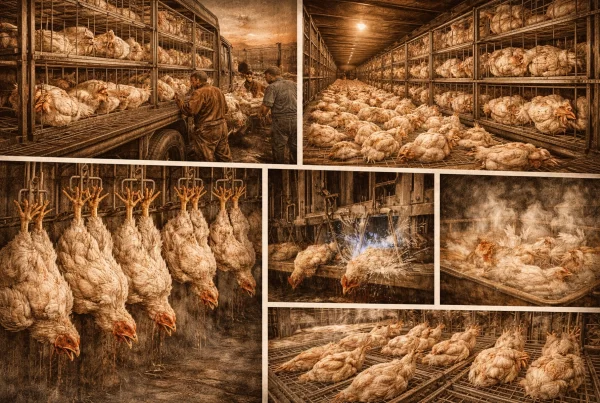
Broilers and laying hens are transported in crowded crates with:
- no food or water
- exposure to extreme temperatures
- rough handling during catching and loading
Handling injuries — dislocated wings, broken bones, bruising — are extremely common. Heat waves can kill thousands of birds during transport.
Scientific reviews confirm that transport is one of the highest-stress periods in the life cycle of poultry.
Slaughter: The final stage of suffering
Most poultry slaughter systems involve:
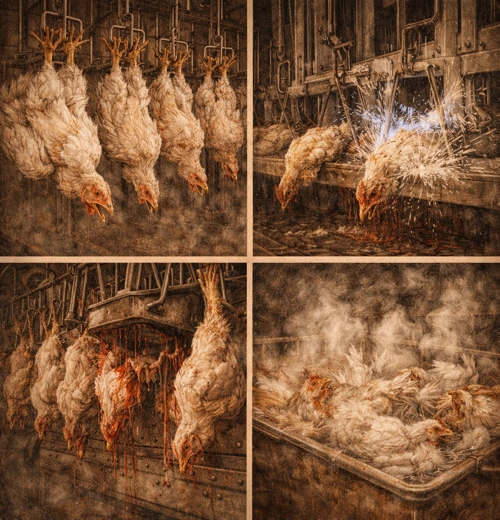
- hanging birds upside down while they are conscious
- electrical stunning
- automatic throat cutting by machine
- immersion in scalding water to remove feathers
Stunning failures are routine.
HSUS reports that up to 3% of birds may enter scalding tanks still alive because of ineffective stunning or wing flapping, which causes birds to miss the blades.
This translates into tens of millions of conscious birds being scalded to death every year in the United States.
Why the treatment of birds is especially severe
Birds suffer disproportionately because:
- They are the most numerous — more than 9 billion broilers per year.
- Their lives are the shortest — only a few weeks.
- Their genetics are the most extreme — rapid growth causes chronic pain.
- Their housing is among the most overcrowded — sheds can hold 40,000 birds.
- They receive the least legal protection — for example, U.S. federal laws exclude poultry from humane slaughter regulation, however paradoxical that phrase may sound.
- Their suffering is invisible — consumers rarely see poultry farms.
From the perspective of animal welfare science, broilers and laying hens experience some of the highest levels of chronic stress, pain and behavioral deprivation in the livestock sector.
What better systems look like
Alternatives supported by CIWF, WOAH and animal welfare scientists include:
For broilers — ideally they would not exist at all, but:
- slower-growing breeds
- lower stocking density
- enrichment — perches, platforms, pecking materials
- improved litter management
- more natural light
For laying hens
- cage-free systems
- enriched barns with perches, nest boxes and dust-bathing areas
- outdoor access
- phasing out traditional battery cages
For hatcheries
- adoption of in-ovo sexing technology
- elimination of male chick killing
These improvements are technologically feasible and are already being implemented in parts of Europe.
Poultry — the most numerous animals in agriculture — endure some of the worst human treatment of all farmed species. Industrial systems confine birds in overcrowded, barren environments, deprive them of natural behavior and impose severe physical suffering through extreme genetics and poor living conditions.
Understanding the suffering of these birds is essential not only for ethical reasons, but also for designing humane food systems. As the evidence shows, poultry welfare problems are not exceptions — they are the structure of the system itself.
Sources:
https://www.humanesociety.org/sites/default/files/docs/hsus-report-animal-welfare-industrial-agriculture.pdf
https://www.ciwf.org.uk/farm-animals/chickens/
https://www.ciwf.org.uk/farm-animals/chickens/broiler-chickens/
https://doi.org/10.1017/S0043933906003233