- Livestock farming is a leading driver of habitat loss
- Pastures and feed crops occupy enormous areas
- Beef is the most land-demanding product
- Deforestation destroys biodiversity
- Fragmentation makes species more vulnerable
- Smaller habitats support fewer species
- Livestock uses much more land than plants
- Plant proteins are much more efficient
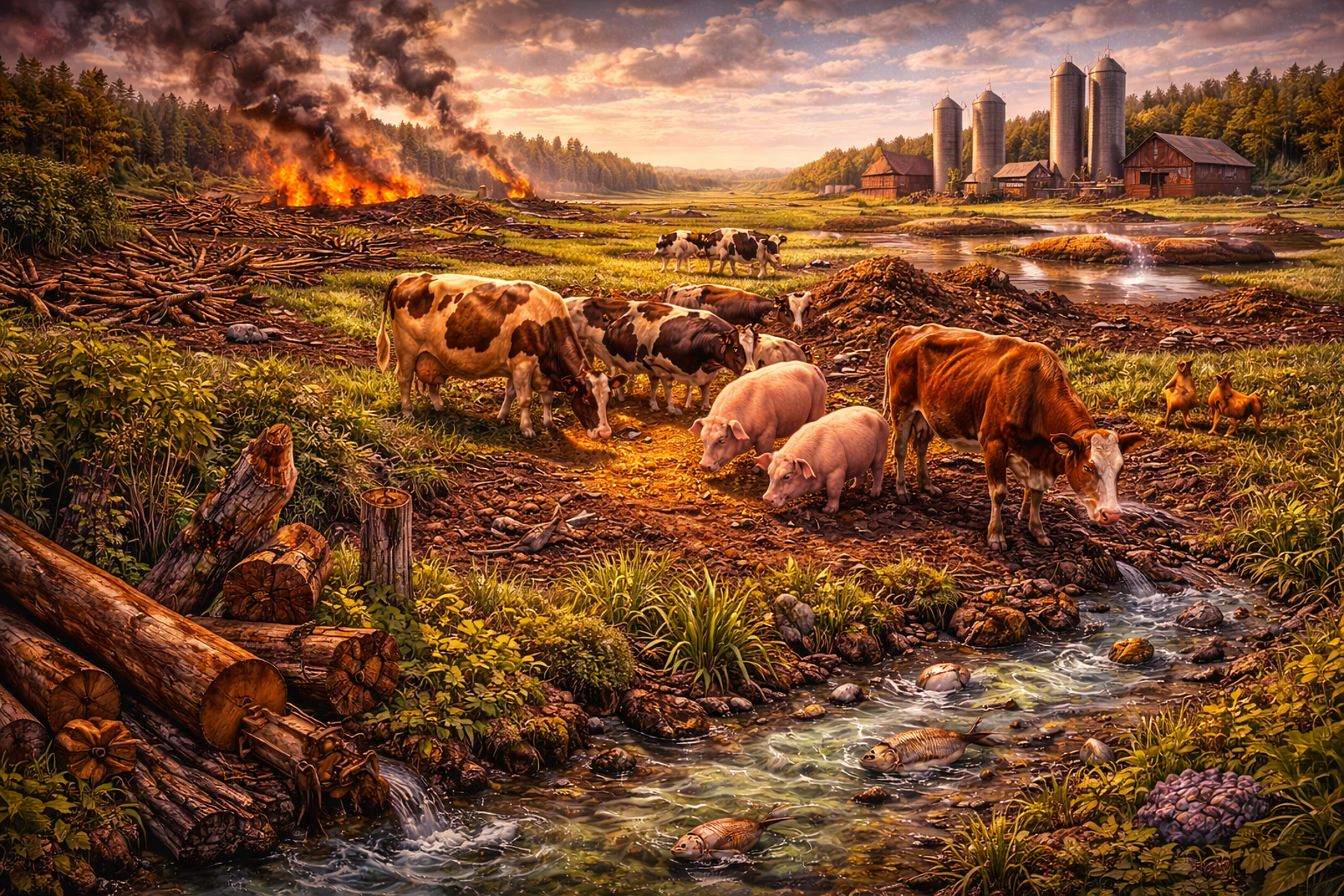
- Pastures and feed crops displace wildlife
- Land loss leads to ecosystem collapse
- The way we eat directly affects land use
- Less meat means more space for nature
We humans live on a small planet, only a small part of which is actually land, and not a particularly large part of that land is habitable for a species like ours. On top of that, there are millions, if not billions, of animal species that inhabit this not-so-large piece of land. And what do we do? Of course, we invent more and more creative ways to destroy the land and the environment under the pretext that we are turning it into areas useful to us.
One of the most common reasons we do this is to grow crops with which we feed ourselves and the animals we eat. In this article, we will look at this “contribution” of ours to the planet we inhabit.
Habitat loss and fragmentation — what are we talking about?
Habitat loss means converting natural ecosystems — forests, grasslands, wetlands — into human-dominated landscapes — pastures, crops, infrastructure — which drastically reduces the ability of ecosystems to support native species.
Habitat fragmentation refers to breaking continuous natural landscapes into smaller, isolated patches.
Together, these activities of ours reduce biodiversity, population sizes and ecological resilience.
Breeding and raising livestock is one of the main causes of this loss, especially through:
- Clearing forests for pasture
- Converting native vegetation for feed crop production
- Fragmenting intact landscapes through infrastructure created by us and the creation of grazing fields, which puts pressure on soils
How does livestock lead to habitat loss?
As cute as cows, pigs and the other animals may be, the way we raise them — and especially their number — creates serious environmental problems:
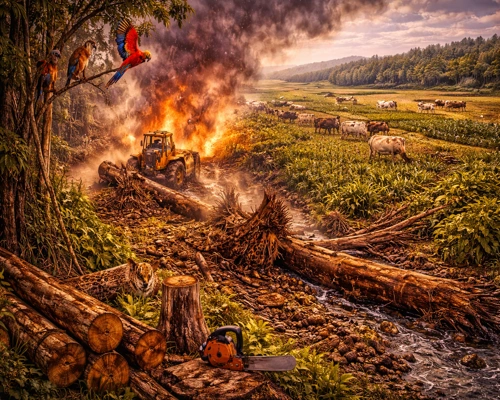
Deforestation for pastures and feed crops
Beef production
- Beef is the biggest driver of deforestation in tropical regions such as the Amazon and the Gran Chaco.
- Forests are cleared to create pastures or space for growing feed crops — soy, corn.
Global land conversion statistics
- Agriculture accounts for >90% of the world’s land converted from natural ecosystems — crops + pastures — while other human activities, such as urban development or mining, are comparatively minor.
- Pasture expansion alone contributes a significant share of biodiversity impact from land-use change; in one major analysis of land-use change impacts from 1995–2022, pastures were responsible for ~21% of agriculture-related biodiversity loss, while cropland contributed ~72%.
The case of the Cerrado and the Amazon
- In the Brazilian Cerrado and Amazon, most species have lost between 25% and 65% of their original range due to agricultural expansion — mainly livestock and soy systems.
Habitat fragmentation
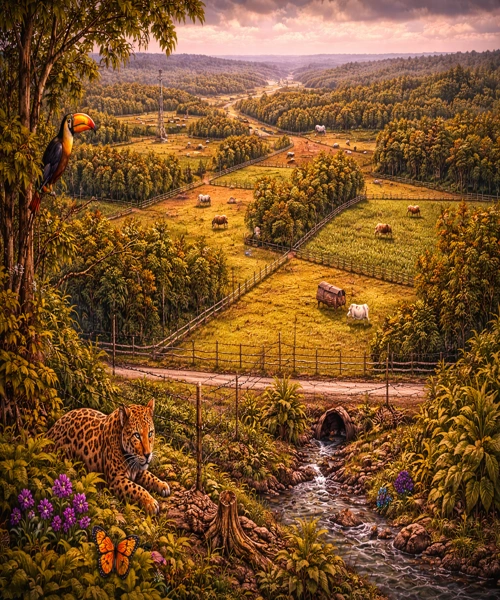
Even without complete clearing, livestock can fragment habitats:
- Fences, roads and infrastructure related to grazing and feed production break large continuous ecosystems into fragments.
- Small, isolated patches support fewer species and suffer from edge effects — altered microclimate, invasion by invasive species and reduced gene flow.
Fragmentation makes species more vulnerable to extinction, even where some natural habitat remains.
Why is this dangerous and what are the consequences?
Impact on the planet
Global land distribution
About 80% of agricultural land is used for livestock — grazing + feed crops.
This takes away and, over time, destroys land better suited for natural ecosystems and reduces the available habitat for biodiversity.
How this affects biodiversity loss
A 2024 global analysis found that agriculture is responsible for >90% of biodiversity impacts due to land-use change, with livestock pastures contributing a major component.
Impacts on forests in key biodiversity hotspots
Historical forest loss in the Amazon — for example, around a 17% reduction in forest cover over several decades — is strongly linked to livestock farming and related feed crop expansion, making this one of the most important biodiversity losses in the world.
Loss of species ranges
In the Amazon and Cerrado, and not only there, extensive measurements show that many vertebrate and reptile species have lost a large part of their original habitat.
Mechanisms of biodiversity reduction from habitat loss
Habitat loss harms biodiversity through:
1. Reduced habitat area
Less total habitat area → fewer species can survive due to space limitations and resource shortages.
2. Fragmentation
Isolated patches:
- Disrupt migration and gene flow
- Increase vulnerability to climate change
- Create edge conditions that favor generalist and invasive species over specialists
3. Ecosystem simplification
Cleared or uniform pastures support fewer species than native forests or grasslands.
4. Landscape degradation
Even where some vegetation remains, grazing pressure, trampling and removal of native flora reduce species richness.
After sharing what is happening and why, it is time to mention some interesting statistics:
Interesting facts
How much habitable land is used for livestock compared with crops directly consumed by humans?
Our World in Data (OWID) reports that:
Around 50% of the world’s habitable land is used for agriculture.
If you combine pastures + cropland used to grow animal feed, livestock uses ~77% of the world’s agricultural land.
The remaining ~23% of agricultural land is used for crops for direct human consumption.
Turning this into a share of habitable land — simple multiplication, even I can do it.
Share of habitable land used for livestock: 50% × 77% = 38.5% of habitable land
Share of habitable land used for direct human crop production: 50% × 23% = 11.5% of habitable land
So livestock uses ~3.3× more habitable land than crops grown directly for people — 38.5% versus 11.5%.
How much land is used to produce 1 kg of beef?
Beef — beef herd: 326.21 m² per kg of product
Important clarification: “land use” is effectively area × time occupied — often expressed as m²·year — and beef has very high variability depending on the production system: grazing intensity, pastures linked to deforestation, and so on.
In the next table we will compare how much land is used to produce 100 g of protein. Nowadays we all train, we want muscles and we need protein. So we do not fall behind:
Food type | m² per 100 g protein |
Veal (beef) | 164 m² |
Lamb and mutton | 185 m² |
Cheese | 88 m² |
Pork | 21 m² |
Poultry | 12 m² |
Tofu | 7 m² |
Legumes (beans/lentils) | 7 m² |
Peas | 6 m² |
Or in other words:
Beef uses ~23× more land than tofu per gram of protein, ~27× more land than peas and ~23× more land than lentils/beans. Or looked at another way — maybe the problem is not the lack of land, but the way we use it.
Sources:
https://www.science.org/doi/10.1126/science.aaq0216#
https://www.alprofoundation.org/scientific-updates/environmental-impact-of-57-000-new-composite-foods
https://pubmed.ncbi.nlm.nih.gov/35939701/
https://typo.weltagrarbericht.de/en/whats-new/news/en/34657.html
https://www.leap.ox.ac.uk/article/estimating-the-environmental-impacts-of-57000-food-products
https://www.pnas.org/doi/10.1073/pnas.2120584119
https://www.researchgate.net/publication/254888015_A_Global_Assessment_of_the_Water_Footprint_of_Farm_Animal_Products