- Reactive nitrogen is a major environmental problem
- Livestock farming is a major source of nitrogen emissions
- Ammonia pollutes the air and harms health
- N₂O warms the climate and damages the ozone layer
- Nitrates pollute soils and waters
- Eutrophication destroys aquatic ecosystems
- Manure intensifies nitrogen pollution
- Feed crops require a lot of fertilizer
- Animal systems are inefficient with nitrogen
- Less meat means fewer nitrogen losses
- Legumes improve nitrogen efficiency
- Plant-based diets reduce pressure on nature
Most of us have heard the saying that the poison is in the dose. In this article we will show that sometimes the key is also in the combination, not only in the quantity. The example we will use is nitrogen. On its own, it is probably the second most useful gas after oxygen, because it makes up 78% of the atmosphere, and when it is in its N₂ molecule, it is inert and harmless — it can even be used to inflate your car tires.
But when it combines with its friends hydrogen or oxygen, it becomes a very naughty boy that can cause a lot of trouble. In this article we will look at what those troubles are, why they happen — as usual, meat and livestock farming are to blame — and what can be done to tame the bad boy.
The problematic compounds we are talking about are the following:
- Ammonia (NH₃)
- Nitrogen oxides (NOₓ)
- Nitrous oxide (N₂O)
- Nitrates (NO₃⁻)
- Nitrites (NO₂⁻)
These forms are biologically and chemically active.
Effects on the atmosphere
Ammonia (NH₃)
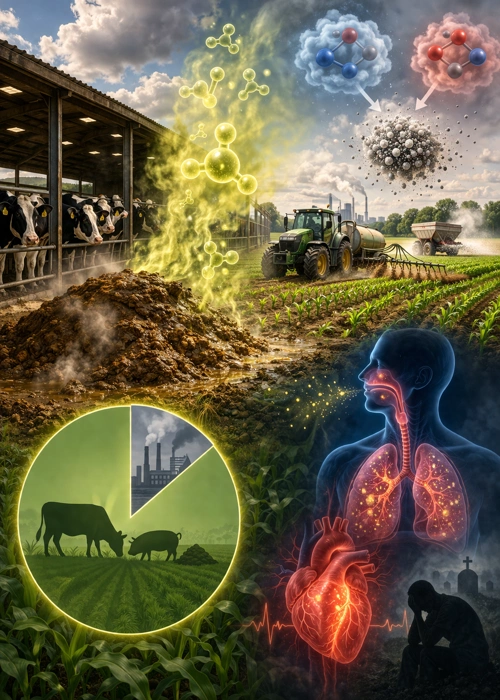
It is released mainly from animal manure and the application of synthetic fertilizers.
Effects:
- Reacts with acids (SO₂, NOₓ) → forms fine particulate matter (PM2.5)
- PM2.5 contributes to:
- Respiratory diseases
- Cardiovascular diseases
- Premature mortality
EU data:
- About 93% of ammonia emissions come from agriculture
- Most of them come from livestock farming and manure
Therefore, ammonia is a major air pollutant.
Nitrous oxide (N₂O)
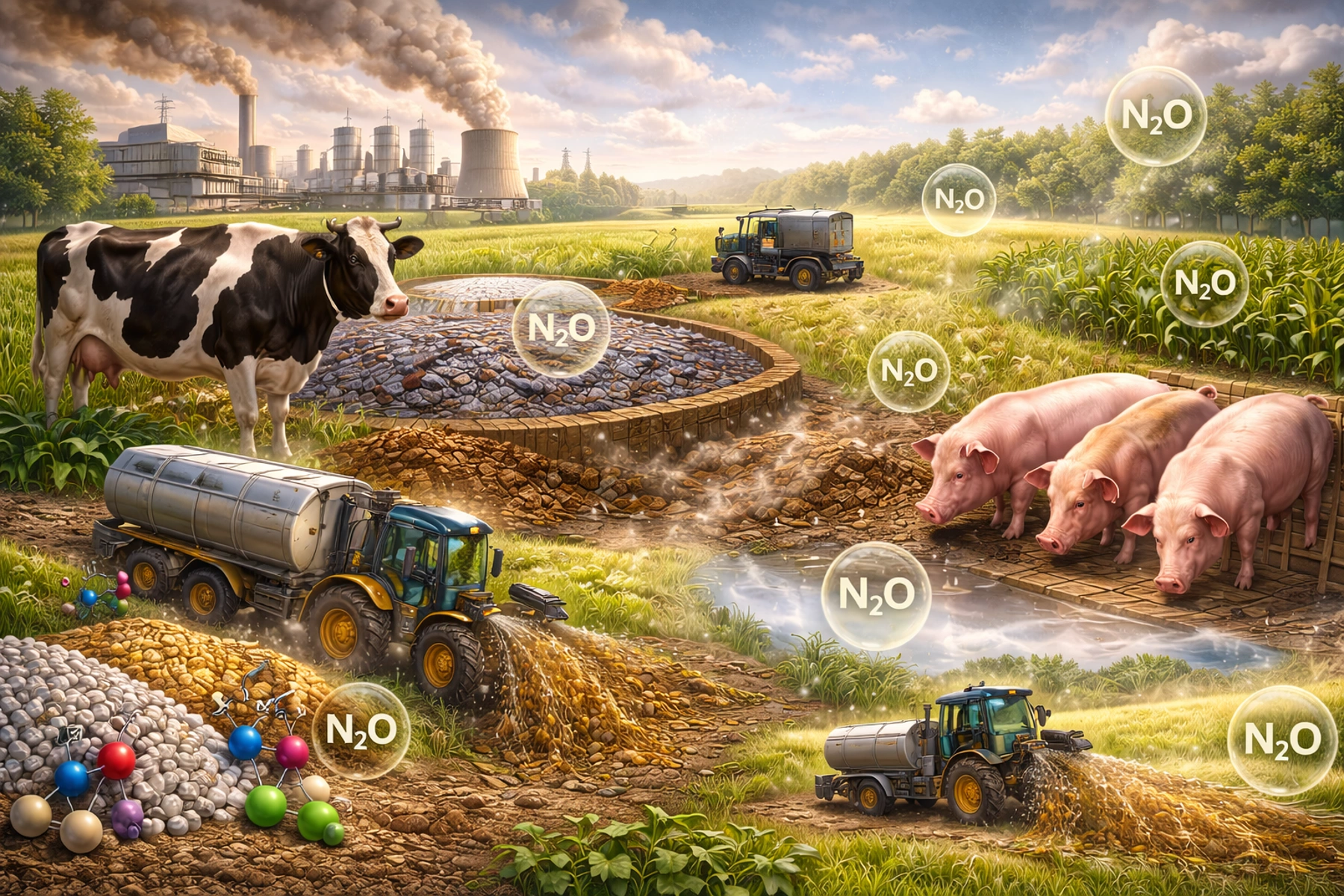
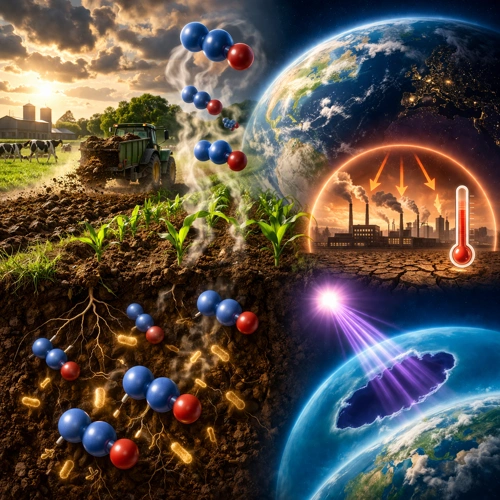
It is produced by soils — fertilizers + manure.
Effects:
- Greenhouse gas
- About 273 times stronger than CO₂ over a 100-year horizon, according to IPCC AR6
- Long atmospheric lifetime — about 114 years
- Also depletes stratospheric ozone
Agriculture is responsible for:
- About 70% of N₂O emissions in the EU
- About 2/3 of global N₂O emissions
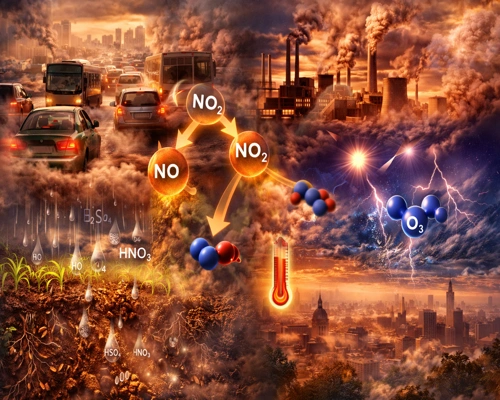
Nitrogen oxides (NOₓ)
From combustion — transport, industry — but also from some soil processes.
Effects:
- Contribute to smog — like the one over Sofia
- Form tropospheric ozone
- Acid rain
They are less typical of livestock farming than their cousins NH₃ and N₂O.
Effects on soil
Excess nitrogen causes:
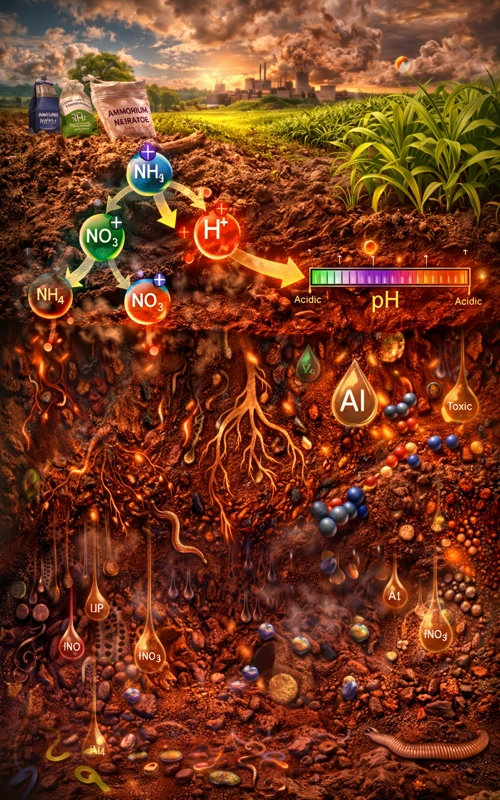
Soil acidification
- Ammonium-based fertilizers turn into nitrates and release hydrogen ions (H⁺)
- Soil pH drops; in other words, acidity increases
Effects:
- Reduced microbial diversity
- Loss of earthworms
- Reduced plant diversity
- Mobilization of toxic metals — aluminum
According to scientific studies, livestock farming is responsible for about 80% of soil acidification impacts in the EU, and the percentage is probably similar for the rest of the world. In other words, not only people, but also our soil is becoming acidic.
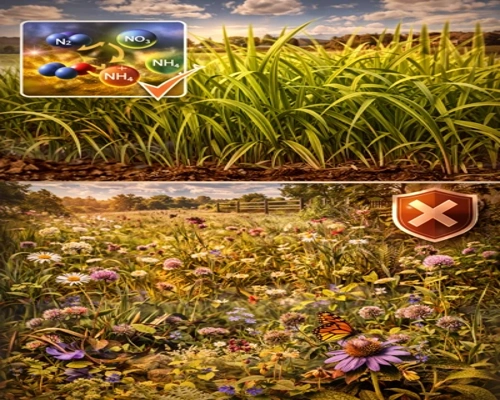
Nutrient imbalance
High nitrogen levels favor:
- Fast-growing species
- Grasses over wildflowers
- Nitrogen-loving plants over biodiversity-rich communities
Result:
- Simplified ecosystems
Lower species richness
Effects on water
This is one of the most serious impacts.
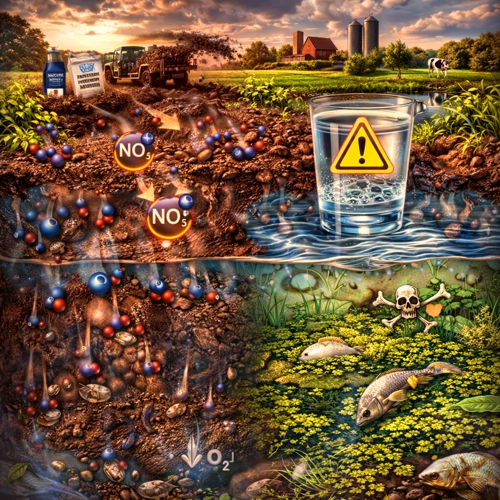
Nitrate leaching (NO₃⁻)
From fertilizers and manure used in fields.
Effects:
- Groundwater contamination
- Risk to drinking water (>50 mg/L EU threshold)
Within the EU:
Agriculture is the main source of nitrate pollution in groundwater.
Eutrophication
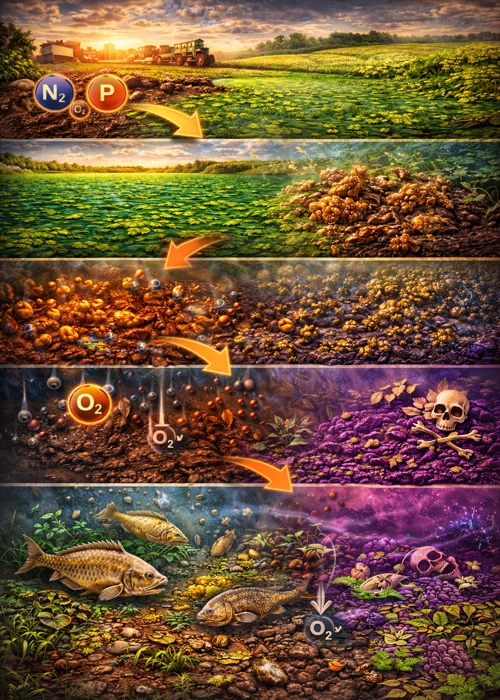
Nitrogen + phosphorus equals nutrient enrichment. At first glance, nothing bad — but what actually happens?
Sequence:
- Algal bloom
- Algae die
- Bacterial decomposition
- Oxygen depletion
- Fish die
Results:
- Dead zones in coastal waters
- Loss of aquatic biodiversity
- Blooms of toxic cyanobacteria, and we get purple water
Agriculture is the dominant source of nutrient runoff in Europe.
The short summary of everything mentioned so far can be found in the table below:
Environmental sector | Basic nitrogen form | Main impact |
Atmosphere | NH₃ | PM2.5 air pollution |
Atmosphere | N₂O | Climate warming + ozone layer depletion |
Soil | NH₄⁺ / NO₃⁻ | Acidification + biodiversity loss |
Water | NO₃⁻ | Groundwater pollution |
Water | Dissolved N | Eutrophication + dead zones |
Mechanisms
After looking at the damage that excess nitrogen and its compounds can cause, we will now look at how they are formed.
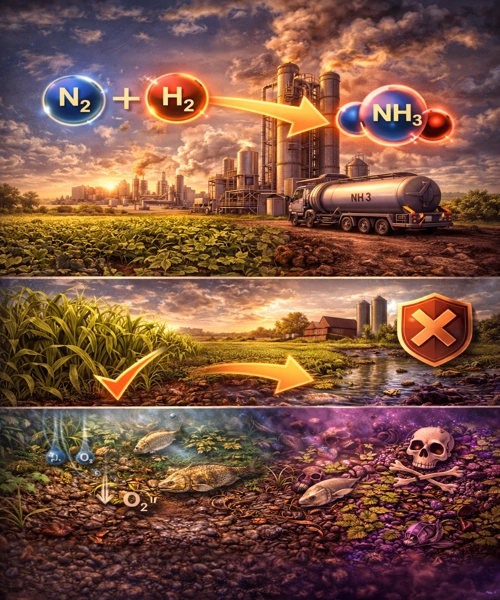
Production of synthetic fertilizers
The chemical reaction is:
N₂ + H₂ → NH₃
This industrial process:
- Turns inert nitrogen into reactive nitrogen
- About 190 million tons of ammonia are produced globally each year
After application:
- Part of the nitrogen is absorbed by crops
- A large share of that amount is lost into the environment
Soil nitrogen transformations
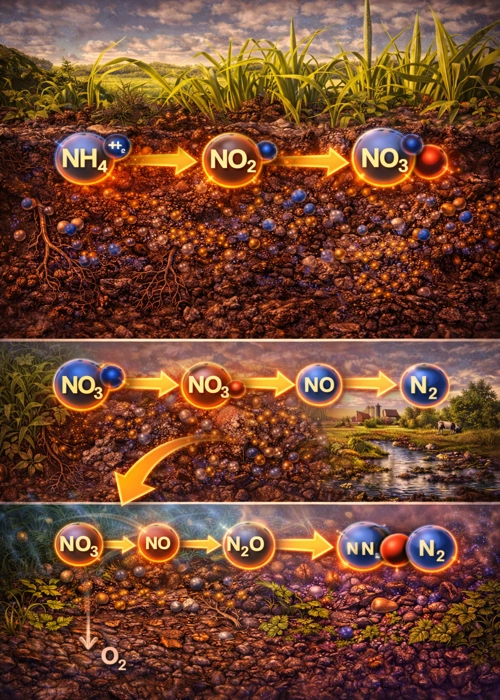
Two microbial processes:
Nitrification
NH₄⁺ → NO₂⁻ → NO₃⁻
Produces:
- Nitrates, which leach into soil and water
- Also N₂O
Denitrification
NO₃⁻ → NO₂⁻ → NO → N₂O → N₂
Produces:
- N₂O, a greenhouse gas
- N₂, harmless
Occurs in:
- Wet soils
- Soils treated with manure
Livestock and the manure cycle
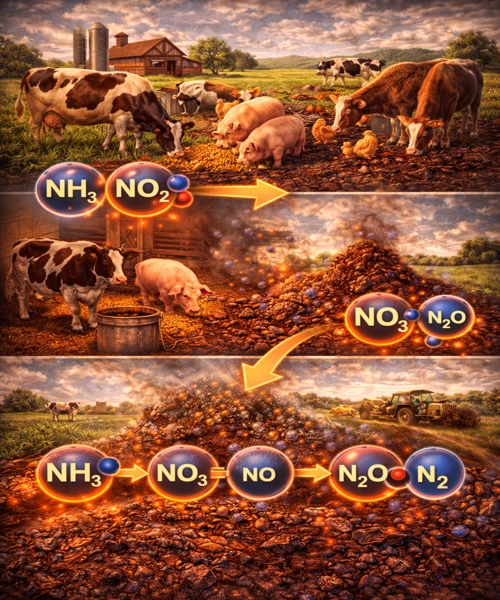
Animals consume protein → excrete 60–90% of their nitrogen intake.
Nitrogen is released:
- In housing areas → NH₃ volatilization
- During storage → NH₃ + N₂O
- After manure application on fields → NH₃ + NO₃⁻ + N₂O
Livestock multiplies nitrogen emissions because it:
- Concentrates nitrogen
- Increases total nitrogen release
Quantitative effect — EU + global
Here is the general data:
- EU agriculture:
- About 93% of ammonia emissions come from agriculture
- About 70% of N₂O emissions come from agriculture
- Most groundwater nitrate pollution also comes from agriculture
Share of livestock farming:
- About 73% of water pollution impacts
- About 80% of acidification impacts
- Dominant factor for NH₃ emissions
Globally:
- Human nitrogen fixation now exceeds natural terrestrial fixation
- The creation of reactive nitrogen has roughly doubled since 1950
- The planetary boundary for nitrogen has been exceeded by ~2×–3×
How does the way we eat affect the nitrogen cycle, and how can we model this effect?
Why the way we eat is actually a factor in the nitrogen cycle
Nitrogen emissions increase with:
- Total amount of fertilizer
- Feed production
- Livestock population
- Manure production
Livestock systems are nitrogen amplifiers:
👉 Animals convert only 10–40% of feed nitrogen into edible protein
👉 The rest becomes manure and emissions
So reducing demand for meat and, respectively, livestock production reduces:
- Fertilizer demand
- Land occupied by feed crops
- Manure nitrogen
- Ammonia emissions
- N₂O emissions
- Nitrate leaching into soils and waters
What modeling studies show
🇪🇺 EU: Leip et al. (2022) — “Halving nitrogen losses”
This is one of the most important recent EU studies.
Main finding:
- Technical measures alone cannot halve nitrogen emissions.
- A significant dietary shift is necessary.
Key results:
- Combining efficiency improvements + dietary changes → up to 49–70% reduction in nitrogen losses
- Dietary change alone could lead to a 20–40% reduction
- Technical measures alone would often lead to less than 20%
The most effective scenario would be the following:
- Reduced livestock production
- Reduced meat consumption
- Increased intake of plant proteins
Potential for quantitative reduction of nitrogen emissions
Let us define it clearly.
Current nitrogen situation in the EU:
Agriculture is the dominant source:
- About 93% of ammonia emissions
- About 70% of N₂O emissions
- Most nitrate pollution
Livestock farming, not the animals themselves, is responsible for:
- About 70–80% of agriculture’s nitrogen-related impact
Dream scenario
50% reduction in meat consumption in the EU
Based on nitrogen-flow models, the possible reductions are:
- Ammonia emissions ↓ 30–50%
- Nitrate leaching ↓ 20–40%
- N₂O emissions ↓ 15–30%
- Total nitrogen surplus ↓ ~30–45%
These are system-level effects because livestock is a driving force behind feed demand.
Ideas for how this could be achieved:
A change in people’s diets would reduce nitrogen losses in 5 ways:
1. Less feed production
↓ fertilizer use
↓ losses from soil nitrification
↓ N₂O emissions
2. Less manure
↓ NH₃ volatilization
↓ nitrate runoff
3. Less nitrogen excretion
The total amount of nitrogen entering the system decreases.
4. Higher nitrogen use efficiency (NUE)
Plant systems that would replace animal farming systems convert nitrogen more efficiently into edible protein.
5. Reduced protein overconsumption
Western diets often exceed protein needs → excess nitrogen is excreted.
Which dietary changes matter most?
Not all reductions are equal.
Reducing beef and dairy products has the greatest impact
Ruminant animals can boast:
- High feed demand
- High nitrogen content in manure
High ammonia emissions
Reducing pork and poultry has a moderate impact
Lower than beef, but still significant because of feed-based systems.
Increasing legumes
Legumes:
- Fix atmospheric nitrogen biologically
- Require fewer synthetic fertilizers
- Increase nitrogen efficiency
- Increase our rectal expressiveness, but that has no relevance to the atmosphere, except the one at home
Replacing animal protein with legumes provides the greatest increase in nitrogen efficiency.
We know your eyes are already tired from reading and you cannot wait to process everything, so we present the following table on converting nitrogen into protein and leave you in peace.
Food product | Nitrogen use efficiency |
Beef | around 10–15% |
Pork | around 20–30% |
Poultry | around 30–40% |
Plant proteins | around 60–90% |