From substitution to restoration, or how reducing animal products can free land and unlock enormous climate benefits
If you do not feel like reading the whole article, remember this:
- Livestock occupies a disproportionate amount of land
- A small amount of animal calories costs enormous areas of land
- Less meat frees millions of square kilometers of land
- Changing diet is a land-use reform
- It reduces pressure on forests and ecosystems
- Agricultural emissions fall significantly
- Water and nitrogen pressure also decrease
- Animals are an inefficient intermediary for calories
- Freed land can capture carbon
- Rewilding becomes possible
- The benefits are both climatic and ecological
- Food choice directly affects land
As you may have understood from our tirades so far in other publications, livestock farming requires enormous amounts of land, and this land is taken from the environment through deforestation and the planting of agricultural crops that are used to feed the poor animals, which are then used so we can scratch our taste buds. If you have not understood it by now, you can read it in our articles.
The other problem is that this land, which is wrestled away from nature, has something like an expiration date, because it is not suited to the type of use required for growing those crops. So, after a while, the land can no longer keep up with the pace required to produce the desired quantities and is often abandoned like an old car in a block parking lot, while deforestation begins on new territories and the cycle repeats.
Let us look at why we are so angry at livestock farming and what it has done to deserve it.
Today:
- ~50% of habitable land is used for agriculture.
- ~75–80% of agricultural land supports livestock (pastures + feed crops).
- And yet animal products provide only a small share of global calories – in other words, the math does not add up.
This creates a structural imbalance:
We use most of our land to produce a relatively small share of food energy.
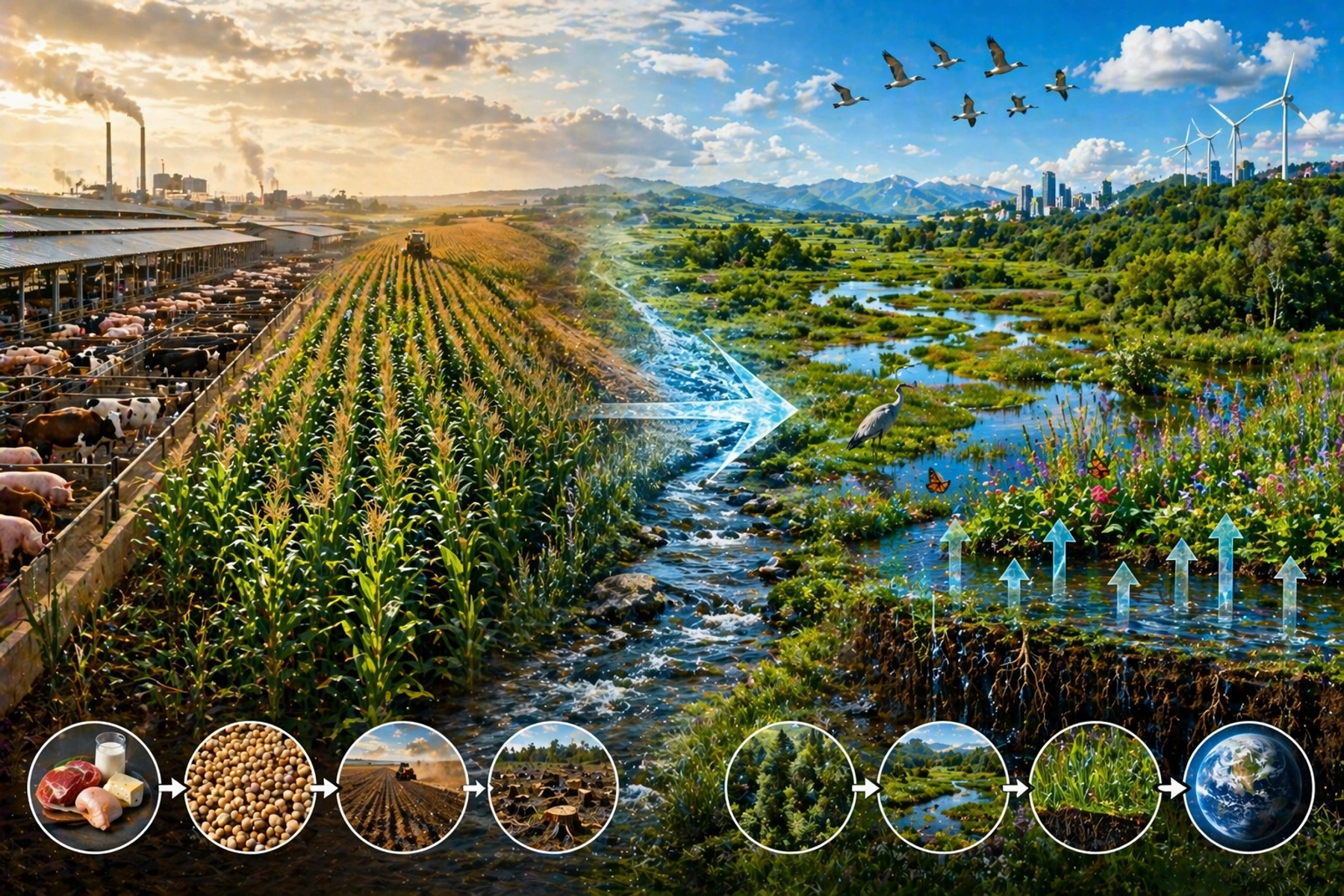
When people consume fewer animal products and replace them with plant-based alternatives:
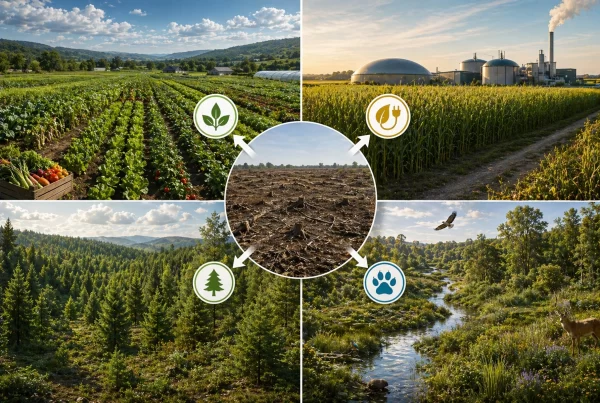
- We do not need so much pasture.
- We do not need so many feed crops.
- We do not need to cut down forests to turn them into new pastures.
The climate benefit would not come only from reduced methane.
It comes from reducing the pressure we put on land through fertilizers, crops and so on.
And pressure on land is one of the biggest drivers of:
- Deforestation
- Biodiversity loss
- Carbon emissions
- Nitrogen runoff
- Water stress
Therefore, dietary change is not simply a food-related solution. It is a structural reform in land use.
50% reduction in consumption – what would happen?
What would happen if we replaced 50% of animal products with their plant-based equivalents or products with similar macronutrient content?
Effect on agricultural land
If we continue on the principle of “business as usual”, agricultural land will continue to expand until, at some point, there is no other land left except agricultural land.
With the possible 50 percent substitution we mentioned:
Agricultural land decreases by about 12%.
This translates into ~6.53 million square kilometers freed.
To imagine it more clearly:
- An area larger than the EU
- Almost as much as Australia’s agricultural land
- ~1.5 times the area of the Amazon rainforest
- 2 times the area of India
This land is not marginal — a large part of it is pasture and feed cropland.

Agricultural emissions
With such a desirable substitution:
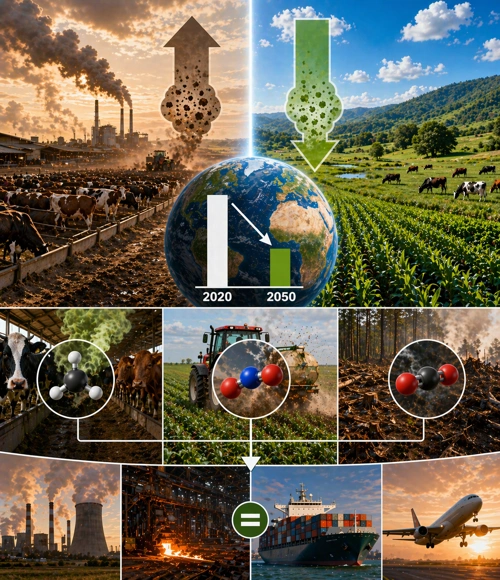
Greenhouse gas emissions from agriculture fall by ~31% by 2050 compared with 2020.
Why?
Because, as we have mentioned more than once, livestock systems are major sources of:
- Methane (enteric fermentation)
- Nitrous oxide (fertilized feed crops)
- CO₂ from land use
This reduction (~2 Gt CO₂-equivalent per year) is comparable to eliminating emissions from major industrial sectors.
Water and nitrogen
Global water consumption would decrease by about 10%.
Nitrogen input increases much less than in the reference scenario.
This is critical because:
Nitrogen pollution leads to:
- Groundwater contamination
- Dead zones in rivers and seas
- Collapse of biodiversity in aquatic systems
Dietary change reduces these upstream burdens.

Why livestock areas are so large — the efficiency problem
Livestock production is biologically inefficient.
Animals consume calories and protein for:
- Metabolism
- Body heat
- Movement
- Inedible tissue
Only a small fraction is converted into edible meat or milk.
Example:
Beef may convert only ~2–10% of feed energy into edible calories.
This inefficiency drives land demand.
Two main reasons stand behind this large demand:
- Grazing
- Feed crops (soy, corn, grains)
When we remove the “middle layer” of animals – their consuming plant food and turning it into tasty steaks and sausages for our insatiable palates:
- Demand for feed drops dramatically
- Grazing can be reduced
- The expansion of cropland slows, or in a utopian future, stops and these areas may even begin to shrink
Direct human consumption of plant crops and products is far more land-efficient.
This is the structural reason why substitution frees hundreds of millions of hectares.
Use of freed land
What can we do with land that is no longer used for pasture and crop production if the need to feed so many animals is reduced?
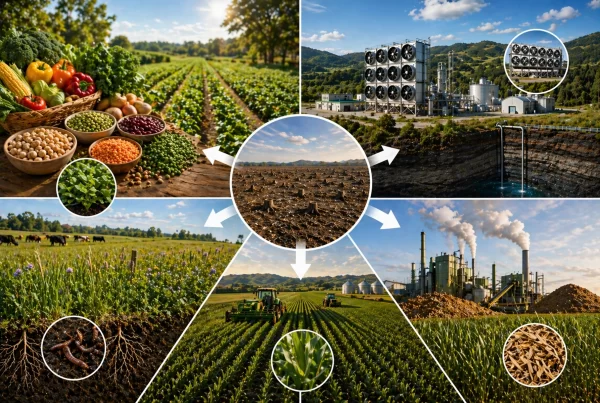
Freed land does not automatically become forest. It requires care and must be managed. If this happens, the land can serve multiple purposes:
Afforestation
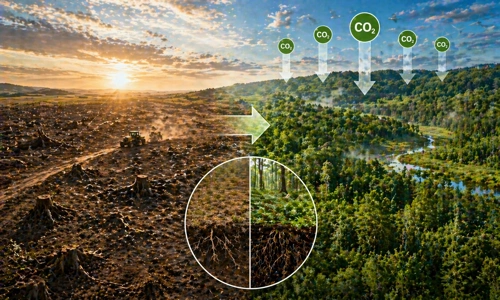
Natural afforestation can capture large amounts of carbon.
Around 1080 Mt CO₂ per year is possible from approximately 83 Mha of suitable land, according to the studies we took the trouble to review.
Scaling up afforestation on abandoned land could multiply this potential.
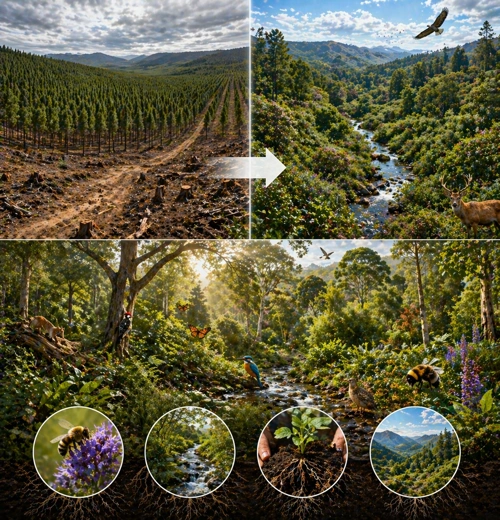
Rewilding
Instead of monoculture tree plantations, allowing ecosystems to regenerate naturally:
- Supports biodiversity
- Restores ecological processes
- Increases resilience
Rewilding often brings greater long-term ecological value than simple afforestation – in other words, not just planting one type of tree for the sake of planting something, but paying attention to the interaction between different plant species that coexist under similar conditions.
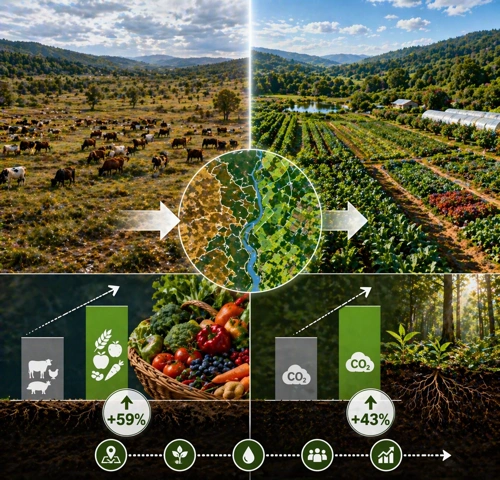
Strategic food restoration
Some freed land may be more suitable for crops than for forests.
Spatial prioritization increases efficiency:
- Up to 59% more food production that would go directly to human consumption rather than to livestock
- Up to 43% more carbon capture
This means that land allocation matters enormously.
If we dig a little deeper into these two main directions, we can learn what results efforts in this area could produce.
Forests and restored ecosystems store carbon in:
- Biomass (trees, vegetation)
- Organic carbon in soil
Average carbon sequestration varies widely:
- Tropical forests: 6–10 tCO₂/hectare/year during early growth
- Temperate forests: 2–5 tCO₂/hectare/year
- Grassland restoration: lower, but still significant
Even conservative global averages (3–6 tCO₂/hectare/year) produce gigaton-scale results when applied to hundreds of millions of hectares.
Key point:
The increase in carbon absorption occurs in the early decades of plant growth.
This makes restoration especially valuable before 2050.
And yet climate is not the only crisis. Biodiversity loss is accelerating worldwide.
Agriculture is a leading driver of:
- Habitat destruction
- Species extinction
- Landscape fragmentation
50% substitution of meat consumption:
- Almost stops the expansion of agriculture into natural land
- Supports climate and biodiversity…
- Significantly reduces ecosystem degradation
If freed land is restored:
- Forest connectivity improves
- Wildlife corridors reappear – repairing, as far as possible, the landscape fragmentation mentioned above
- Species ranges expand
- Ecosystem connections are restored
Restored land contributes to:
- The Kunming-Montreal biodiversity targets
- National nature-conservation commitments
This makes dietary change a biodiversity strategy, not only a climate strategy.
The combined conclusion from the two directions mentioned above, which we could reach with a little goodwill, is that:
Food substitution is not simply an emissions-reduction strategy.
It is an intervention in land use.
And land-use interventions can:
- Reduce agricultural emissions
- Enable carbon capture
- Restore biodiversity
- Improve water systems
- Increase the resilience of species and nature
Few climate strategies work simultaneously across all these dimensions. So that we do not look like evil vegan cultists, we leave it to you to think about whether it is worth reducing or completely stopping your consumption of meat and dairy products.
Sources:
https://www.nature.com/articles/s41467-023-41837-y Nature
https://pubmed.ncbi.nlm.nih.gov/39242882/ PubMed
https://www.researchgate.net/publication/368350535_Rewilding_abandoned_farmland_has_greater_sustainability_benefits_than_afforestation
https://www.nateko.lu.se/lanhui-wang/publication/f06de2b0-9451-48d8-8ecc-26acd93d6e88
https://www.nature.com/articles/s41467-023-40899-2
https://ourworldindata.org/land-use-diets