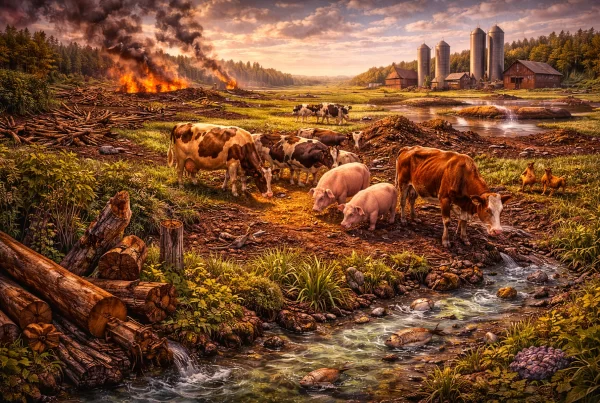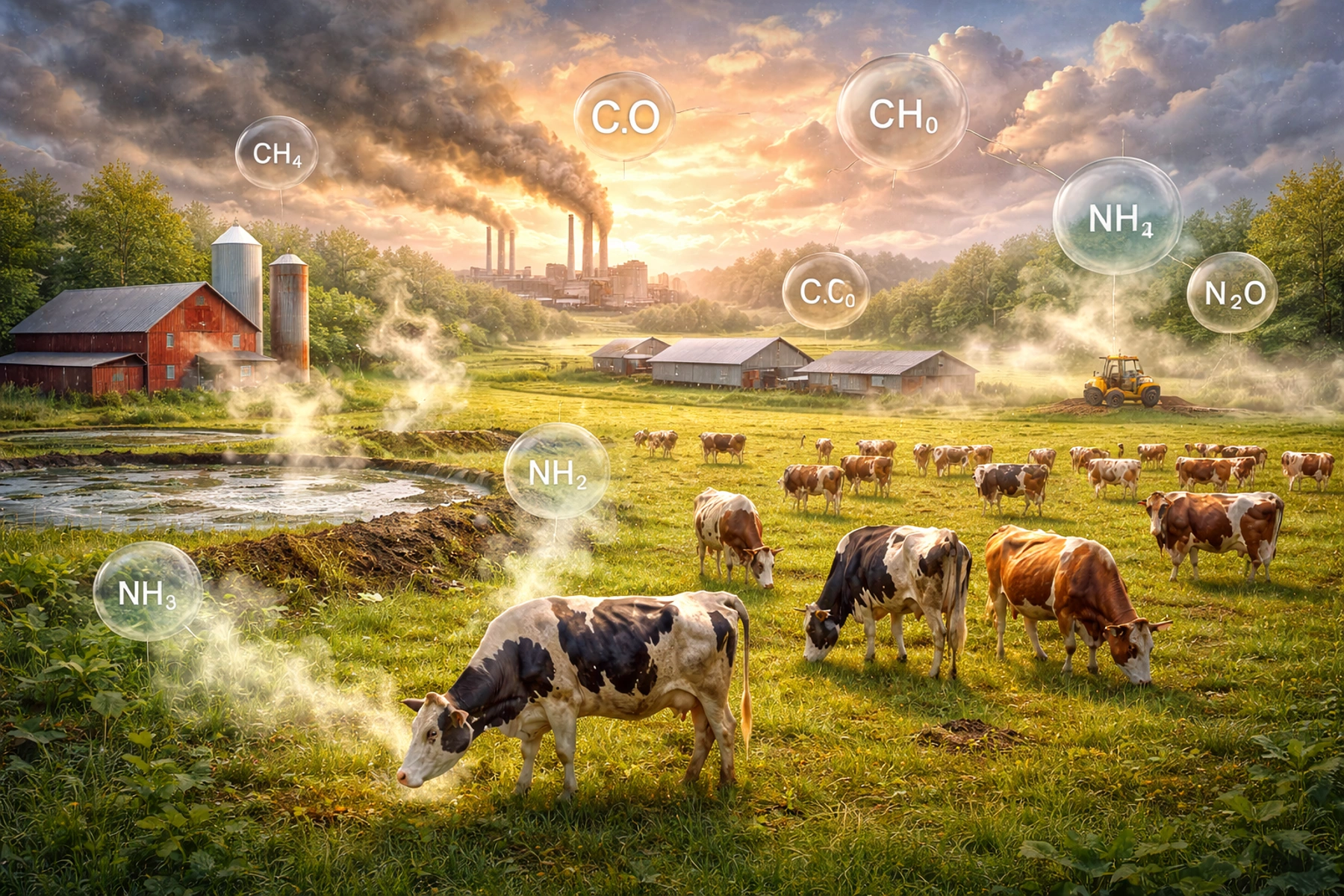
- Food has a large climate footprint
- Livestock farming is a major source of emissions
- Methane from ruminants is a key problem
- Feed and manure add major emissions
- Deforestation significantly amplifies the effect
- Food choice directly affects the climate
- Beef is the most polluting food
- Pork and chicken also have a high footprint
- Plant foods emit many times less
- Legumes are among the most efficient choices
- Eating plants directly is more efficient
- Replacing beef with legumes saves a lot of emissions
Have you ever thought about where the food we eat comes from? Most people would say yes — from the shop, from farms, fields, and so on. But how many of us think about what the food we eat costs nature, and that is exactly what we will look at in this article — what the consequences are for nature, and for people too. Here we will explore, without going too deeply into major details, the consequences in terms of atmospheric pollution caused by the food industry, and we will compare the footprint of meat production with that of plant foods.
The production of plant-based food products releases between 10 and 50 times fewer gases that contribute to the greenhouse effect. Let us see why this is the case.
Why and how does the livestock industry produce greenhouse gases?
- The gases in question, which have a harmful effect on our planet’s atmosphere, are produced in 5 main ways:
- Enteric fermentation — methane from digestion
- Feed production — fertilizers, diesel, soil nitrous oxide
- Manure management — methane + nitrous oxide
- Land-use change — deforestation, loss of soil carbon
- Energy use in processing, transport, and refrigeration
These factors interact to create one of the highest-emission sectors in the food system.
Enteric fermentation
Methane from ruminant animals
(A major emissions driver for cattle, sheep, and goats)
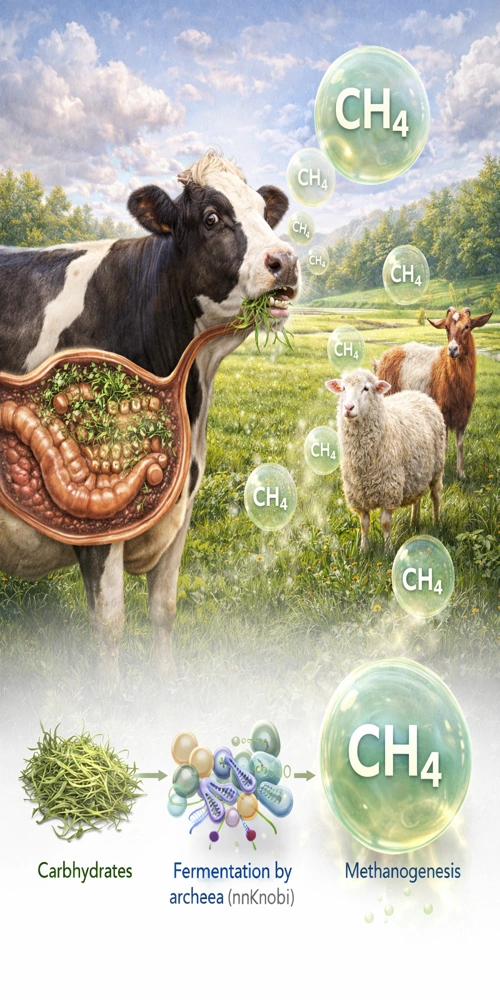
Ruminant animals (cows, sheep, goats) digest food in a four-chambered stomach (rumen), where microbes break down cellulose. This microbial process produces methane (CH₄) as a by-product, which is released into the atmosphere in a rather aromatic way.
Key facts:
- Methane has 86 times the warming effect of CO₂ over 20 years.
- 95% of methane from cattle is released through burping, not flatulence.
- One cow emits 120–220 kg of CH₄ per year.
- This represents 40–50% of all greenhouse gas emissions from beef.
Summary of the mechanism:
Carbohydrates → fermented by archaea (microbes that perform fermentation) → hydrogen (H₂) + carbon dioxide (CO₂) → methanogenesis → released methane (CH₄). This is why beef and lamb have exponentially higher emissions than any plant food.
Feed production
Fertilizers, machinery, transport (Main source for chicken, pork, dairy products, and eggs)
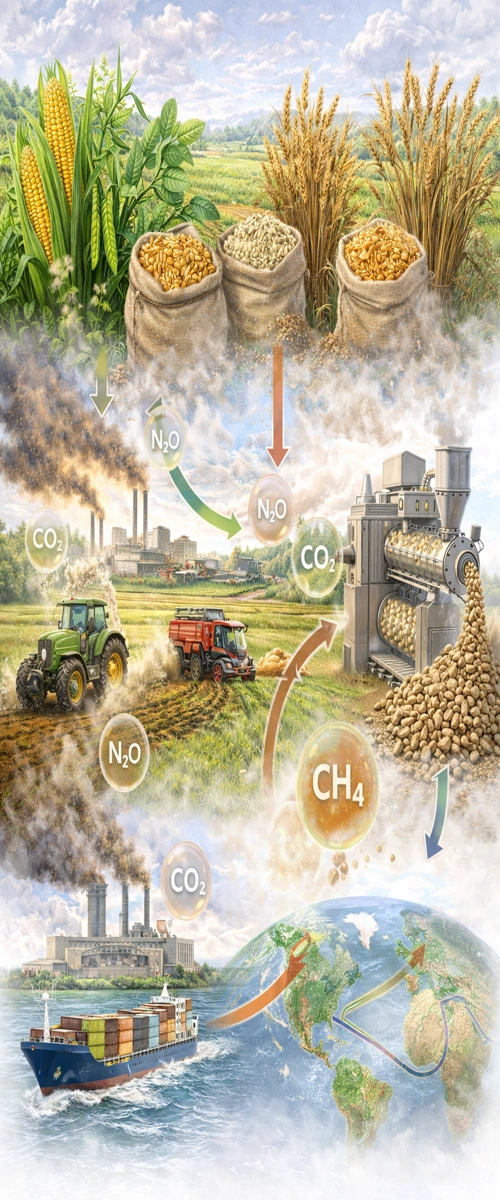
Most animals do not have the luxury of grazing; they are fed industrial feed:
- Corn
- Soy
- Wheat
- Barley
- Oilseed meals
Sources of emissions in this case are:
- Nitrogen fertilizers
- Their production emits CO₂
- Their application emits nitrous oxide (N₂O) — a gas 298 times stronger than CO₂
- Diesel for tractors and machinery
- Energy for irrigation
- Processing feed into pellets
- Global transport (soy from Brazil/Argentina, transported for example to the EU/China)
Comparison of energy and emission intensity:
- Chicken and pork rely heavily on industrial feed, which leads to high emissions from fertilizers and soil
- Beef feedlots also use large amounts of corn/soy during the finishing phase
- Plant foods eaten directly bypass all of this entirely
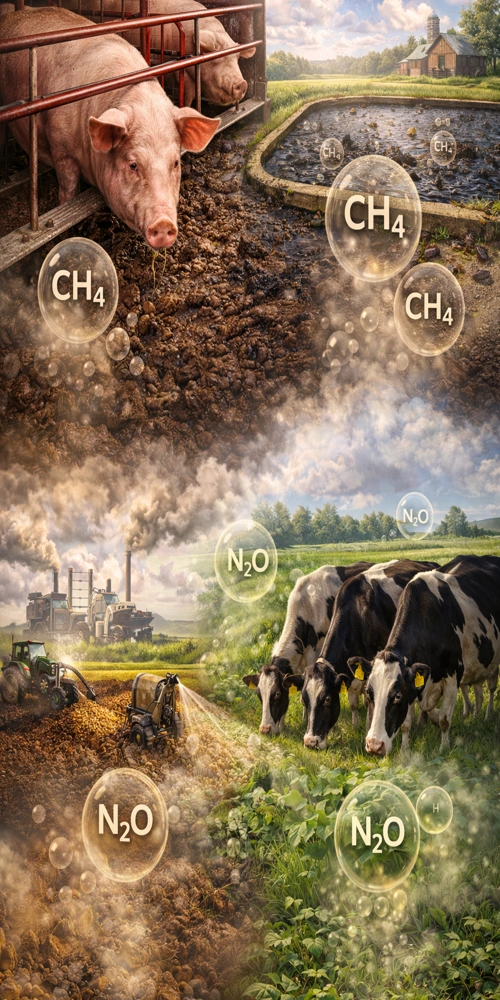
Manure management
Methane + nitrous oxide
Livestock produces billions of tons of manure every year — how does that sound?
Manure releases two main greenhouse gases:
- Methane (anaerobic decomposition)
- Nitrous oxide (nitrification/denitrification of nitrogen-rich waste)
High-emission manure systems:
- Lagoons (large ponds of liquid waste) → high methane content
- Deep pits under barns → methane
- Manure on open fields → nitrous oxide
- Spreading manure on sprayed fields → nitrous oxide
Pigs and dairy cows are major sources of methane through manure, because their manure is stored in liquid systems.
Global share of greenhouse gases from manure:
- 10–15% of total livestock emissions
- Up to 25% in industrial pig and dairy systems
Land-use change — the hidden giant of livestock emissions
This is often the largest factor for beef.
Land use for livestock:
- 80% of all agricultural land on Earth
- Provides only 18% of global calories and 37% of protein
Two main mechanisms:
A) Deforestation for pasture
Especially in:
- The Amazon rainforest
- The Cerrado savanna
- The Congo Basin
All three are quite far from us, but this is a process that happens all over the world. In Europe, it happened a long time ago, and for that reason we have taken it for granted that it is normal for not everything to be covered in forests and trees.
When forests are cut down:
- Carbon is released from biomass → huge CO₂ emissions
- Carbon is lost from the soil and enters the atmosphere
- A long-lasting warming effect (unlike methane, which breaks down, although over a long time)
B) Clearing land for feed crops
Brazil produces 70–80% of the soy used as animal feed globally.
Clearing forests so the land can be used to grow soy leads to CO₂ being released from the soil and entering the atmosphere + the creation of biomass, which is often burned and releases even more CO₂.
Total effect:
Land-use changes contribute:
- 41% of total emissions for beef
- Up to 60–70% when deforestation is included (Poore & Nemecek 2018)
This is why beef from deforestation regions has 10 times higher emissions than beef from temperate climates — significantly higher than plants when we use them for food.
Energy use: processing, refrigeration, transport
Animal products require:
- Slaughterhouses
- Rendering facilities
- Refrigerated transport (“cold chain”)
- Long storage periods
- High disinfection requirements
Sources of emissions:
- Fossil fuels for refrigeration
- Electricity for processing
- Heat for sterilization
- Packaging emissions
These emissions are small compared with methane and land use, but they still exceed those of most plant foods.

Summary — quantitative breakdown:
Where do livestock emissions come from?
Beef (global average):
- Enteric methane: 40–50%
- Land-use change: 30–40%
- Feed production: 10–15%
- Manure: 5–10%
- Energy/transport: 3–5%
Pork:
- Feed production: 60–70%
- Manure: 20–30%
- Energy: 10%
- Enteric methane: negligible
Chicken:
- Feed production: 70–80%
- Manure: 10–20%
- Energy: 5–10%
Dairy products:
A combination of the beef profile + manure:
- Enteric methane: 40–60%
- Feed: 25–35%
- Manure: 15–20%
Beef (global average):
- Enteric methane: 40–50%
- Land-use change: 30–40%
- Feed production: 10–15%
- Manure: 5–10%
- Energy/transport: 3–5%
Pork:
- Feed production: 60–70%
- Manure: 20–30%
- Energy: 10%
- Enteric methane: negligible
Chicken:
- Feed production: 70–80%
- Manure: 10–20%
- Energy: 5–10%
Dairy products:
A combination of the beef profile + manure:
- Enteric methane: 40–60%
- Feed: 25–35%
- Manure: 15–20%
Why does meat produce so many greenhouse emissions compared with plants?
- The biology of ruminant animals inherently creates methane
- Inefficiency of feed conversion
- Plants → animals → humans = energy loss
- Plants → humans = direct intake
- Huge land requirements for pasture → deforestation + CO₂ released into the atmosphere
- Manure produces two super-active gases
- Animal systems are multi-stage (plants → animals → transport → processing → refrigeration)
Plants avoid:
- Methane
- Manure gases
- Heavy fertilizer needs
- Deforestation in most cases
- Cold-chain emissions
So far, we have spoken in relative terms, and now we will show you more precise figures that will help us understand what everything mentioned so far actually means.
Global greenhouse gas emissions by sector (2019)
Data source: IPCC AR6 WGIII Chapter 2 (sector shares for 2019 + GtCO₂-eq.).
Percentage pollution of the atmosphere by sector:
- Energy: 20 GtCO₂-eq. (34%)
- Industry: 14 GtCO₂-eq. (24%)
- AFOLU (Agriculture, Forestry and Other Land Use): 13 GtCO₂-eq. (22%)
- Transport: 8.7 GtCO₂-eq. (15%)
- Buildings: 3.3 GtCO₂-eq. (5.6%)
Greenhouse gas emissions by food type (global averages)
Breakdown by food (kg CO₂-eq. per kg of product)
- Beef: 99.48
- Cheese: 23.88
- Pork: 12.31
- Chicken (poultry): 9.87
- Milk: 3.15
- Tofu: 3.16
- Legumes (beans/lentils) (dataset category “Other pulses”): 1.79
- Peas: 0.98
A few ratios from this breakdown
- Beef vs. tofu: 99.48 / 3.16 ≈ 31× higher
- Beef vs. legumes: 99.48 / 1.79 ≈ 56× higher
- Pork vs. legumes: 12.31 / 1.79 ≈ 6.9× higher
- Chicken vs. legumes: 9.87 / 1.79 ≈ 5.5× higher
Ideas
As a conclusion to the article, we will make one simple calculation. Let us say that an average person eats 1 kg of beef per week, or for easier math, 50 kg per year.
Their contribution from this action alone to the “health” of the atmosphere is:
50 x 99.48 kg CO₂-eq. = 4974 kg CO₂-eq. per year
If they replace those 50 kg of beef not with 50, but with 100 kg of legumes, so they can get everything they need, then the “contribution” would be:
100 x 1.79 kg CO₂-eq. = 179 kg CO₂-eq. per year
In other words, such a change would have the following result:
4974 kg CO₂-eq. – 179 kg CO₂-eq. = 4795 kg CO₂-eq. in one year.
I think it is worth trying to make such a change. What about you?
Sources:
https://zenodo.org/records/14916809
https://science.org/doi/10.1126/science.aaq0216
https://www.fao.org/3/a0701e/a0701e.pdf
https://www.ipcc.ch/report/ar6/wg3/downloads/report/IPCC_AR6_WGIII_Chapter02.pdf
https://ourworldindata.org/food-choice-vs-eating-local
https://ourworldindata.org/grapher/ghg-per-kg-poore