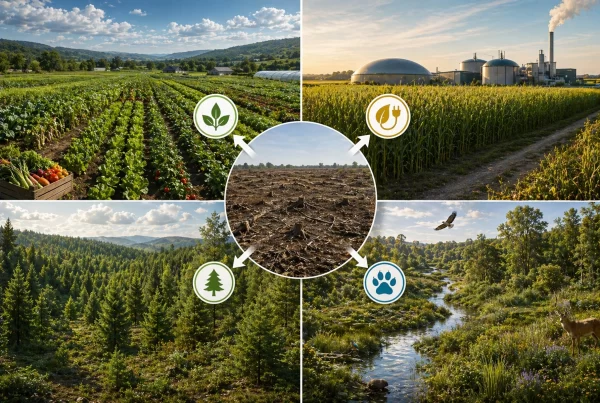
- Diet is a powerful climate tool
- Dietary change is among the most effective measures
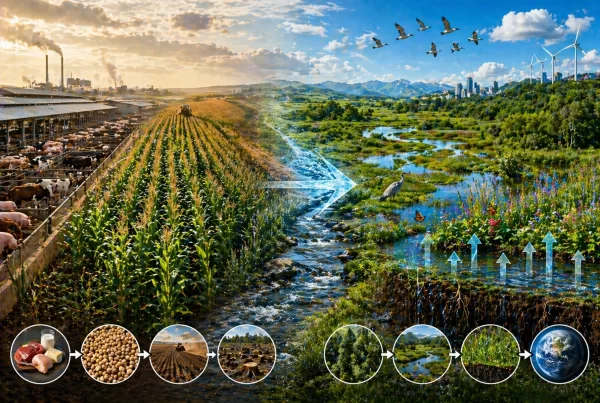
- Less meat frees land and reduces emissions
- Restored land can capture carbon
- CCS and DAC are important, but expensive
- Regenerative agriculture helps, but is not enough on its own
- Higher yields work only with land-use control
- BECCS has potential, but also major risks
- Dietary change brings many co-benefits
- Technologies do not replace demand-side change
- The best approach is a combination of measures
- Climate efficiency depends on both cost and land
The damage we cause every day to our atmosphere and climate is a fact that almost all people on this planet agree with, have become used to, and have even accepted as something normal. But how often do we think about what can be done to reduce our wonderful influence? Many of us try to drive less, use electric cars, or consume foods that were produced locally and do not require so many transport emissions.
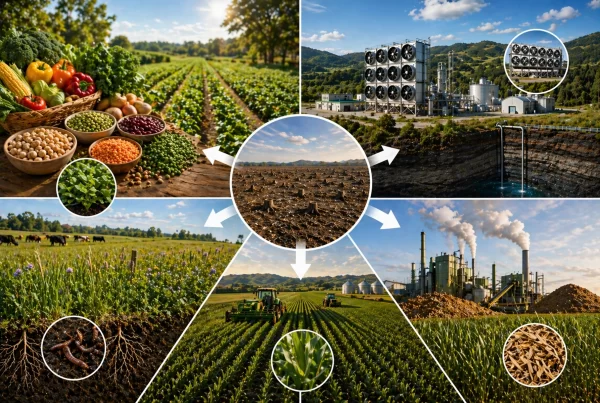
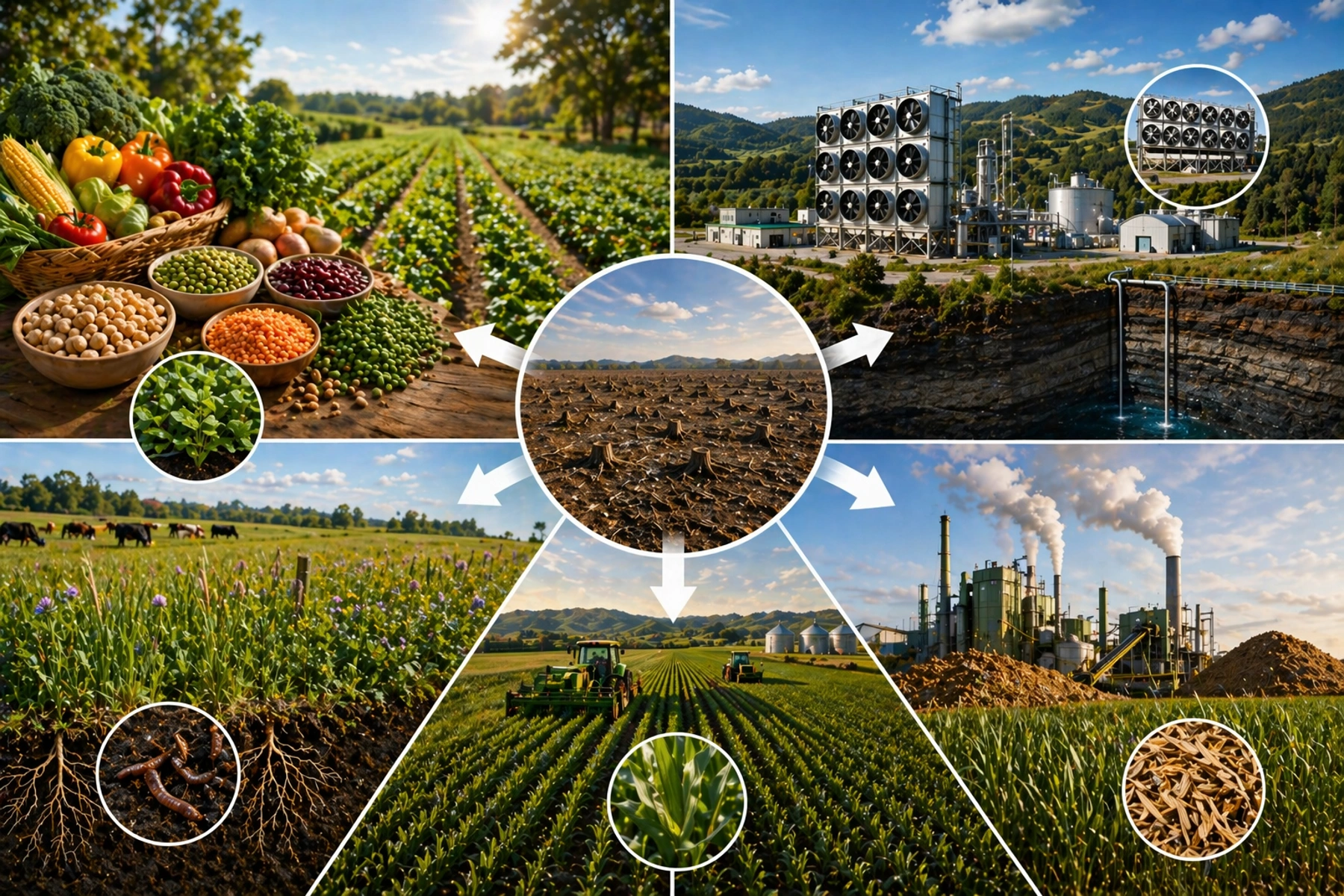
But I assume not many of us have thought about how what we eat actually affects carbon emissions by itself, and what can be done on a personal and national level to reduce, a little or even a lot, the damage we cause. We will look at and compare five methods through which, on a personal, local and let us say national level, we can improve our ecological footprint.
- Dietary change (less meat, more plants / plant-based meat alternatives or imitations – PBMAs)
- Carbon capture and storage (CCS / DAC)
- Regenerative agriculture
- Yield improvements
- Bioenergy with carbon capture systems – CCS (BECCS)
And we will look at them from two main perspectives:
Mitigation per hectare, decare, or whichever land unit you prefer (how much CO₂ impact each technology has per unit of land)
Mitigation per dollar, euro, and soon no more lev (rough value-for-money / difficulty ratio)
This will be more qualitative and indicative than extremely precise in terms of monetary value per ton, because estimates vary significantly, but we can still rank them.
The main problem
We need huge CO₂ reductions, and preferably quickly, because winter is almost gone:
- Significant reduction of emissions (fossil fuels + agriculture)
- Plus removal of CO₂ that is already in the atmosphere
Most climate discussions focus on technologies:
- Carbon capture (CCS) in factories
- Direct air capture
- Bioenergy with CCS (BECCS)
- Precision agriculture, etc.
But there is a demand-side lever that is often overlooked:
Changing what we consume – especially food – can reduce emissions and free land for carbon storage.
So: how does “eating differently” really compare with “building machines and technological innovation”?
Method 1 – Dietary change (less meat, more plants)
What it is
- Consuming fewer animal products, especially beef and dairy products
- Replacing them with plant foods and/or PBMAs
- It does not require new physical infrastructure, apart from adjustments in the food supply chain
Mitigation per hectare
A 50% global replacement of meat and dairy products with plant-based alternatives by 2050 would lead to:
- ~31% reduction in agricultural emissions
- ~653 Mha of freed land
This freed land can be restored:
- Potentially 1–3 Gt CO₂/year of additional capture, if a large part of the land is allowed to recover as forest/rewilded land (depending on allocation and region, using the logic from the abandoned cropland paper).
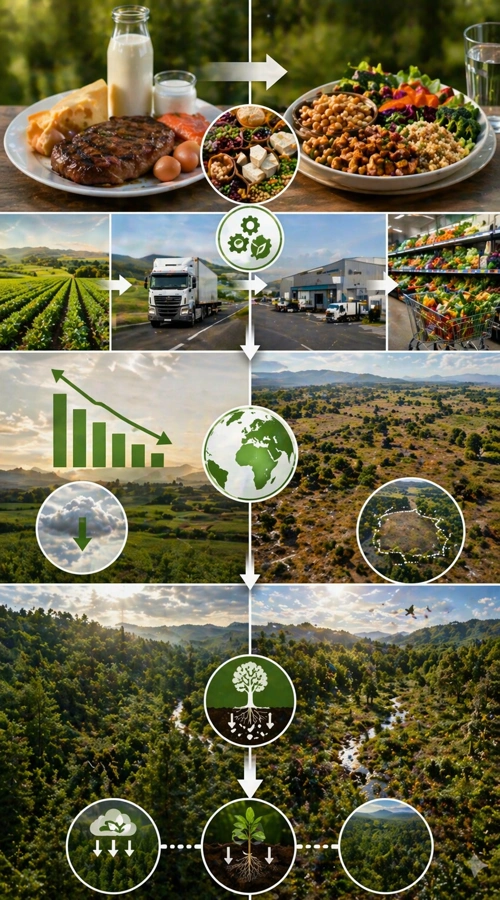
This makes dietary change + land restoration extremely effective tools, because:
- You reduce current emissions (methane + N₂O), and
- You unlock land for CO₂ removal through the regrowth of forests and plants
Mitigation per dollar
- The main “cost” is mostly:
- Changing habits
- Reformulating products
- Changing policies
- There is no need for massive new hardware or fuel inputs.
The cost per ton of absorbed CO₂ is generally considered very low compared with engineered removal, especially when co-benefits are included (healthcare savings, water, nitrogen).
Additional co-benefits
- Health (less saturated fat, more fiber – if well designed)
- Less nitrogen pollution
- Less water stress because the water needed in livestock production would be saved
- Biodiversity benefits
Limitation
- Social and cultural resistance
- Political difficulty (meat is identity + economy)
Method 2 – Carbon capture and storage
(From plants and factories / Direct air capture)
What it is
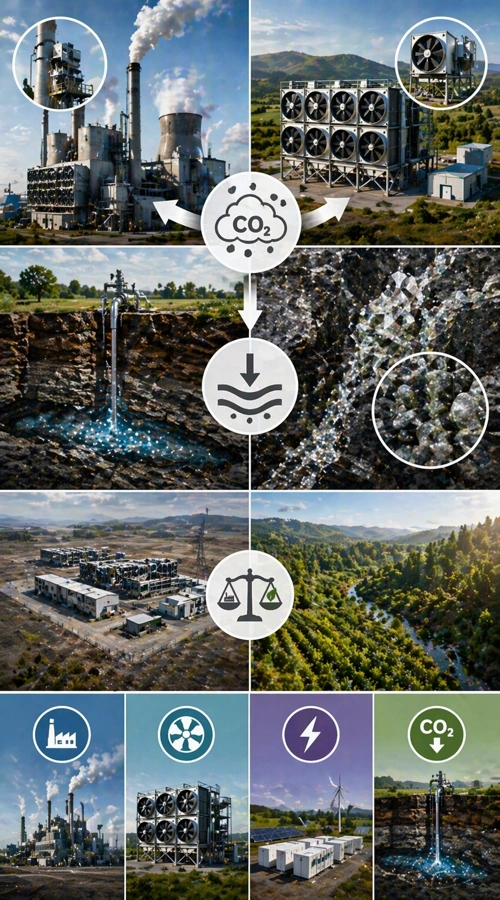
- Capturing CO₂ from:
- Power plants / factories (CCS – carbon capture technologies – from a point source)
- Diluted air (DAC – direct air capture)
- Pumping it underground or mineralizing it
Mitigation per hectare
- CCS on smokestacks does not use much land; it is mostly an industrial footprint.
- DAC often needs:
- Energy facilities
- Fans/units
- Supporting infrastructure
Per hectare of land, CCS/DAC is not as “efficient a land use” as turning abandoned agricultural land into forest – you are using that land mainly for machines and energy rather than ecosystems.
Mitigation per dollar
- CCS on concentrated sources:
- Often estimated in the range of $50 to $150 per ton of CO₂ (varies a lot).
- DAC:
- Currently very expensive – often in the range of $400 to $1000+ per ton of CO₂ for real projects.
Technically, it is crucial (hard-to-abate sectors, long-term negative emissions), but it is not cheap, and scaling to gigatons is capital-intensive.
Co-benefits
- Keeps part of industry running while it decarbonizes
- Avoids disruption of jobs in certain sectors
Limitations
- Huge energy demand
- High cost
Method 3 – Regenerative agriculture
What it is
Practices such as:
- Cover crops
- Reduced tillage
- Agroforestry
- Diverse rotations
- Better grazing management
Goal: improve soil health, retain more carbon in soils, reduce erosion and input needs.
Mitigation per hectare
Soil carbon storage:
- Often 0.5–3 tCO₂/ha/year in many systems, depending on climate, initial condition and practices.
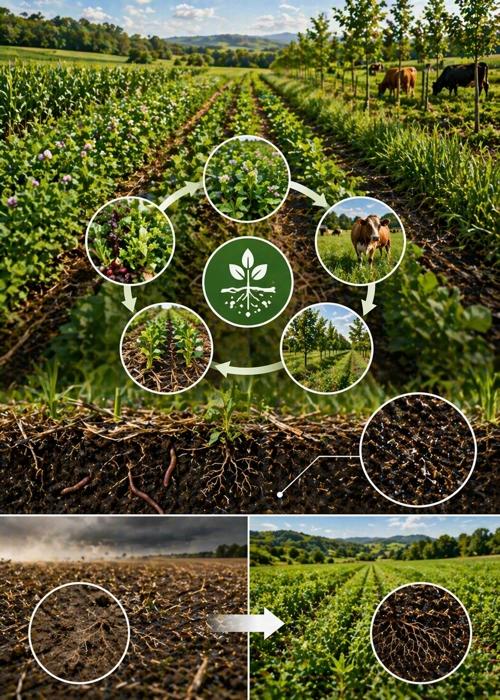
This is useful, but:
- Usually less effective per hectare of land than turning cropland/pasture back into forests/restored ecosystems.
- Vulnerable: soil carbon can be released back into the atmosphere if practices change or climate extremes occur.
It also reduces:
- Nitrous oxide (better nitrogen management)
- Some fossil fuel use (less tillage, etc.)
Mitigation per dollar
Often moderately cheap:
- Sometimes cost-neutral or even profitable for farmers (less fertilizer, better yields in the long term)
- Sometimes requires upfront support/training
But on its own it rarely delivers huge CO₂ savings at the scale needed; it is more of a supporting strategy.
Co-benefits
- Soil health
- Drought resilience
- Reduced runoff
- Can be farmer-friendly
Limitations
- Risk of overstating benefits – regenerative agriculture alone will not offset fossil fuel emissions
- Strict measurement and verification are needed to avoid abuse
Method 4 – Yield improvements
What it is
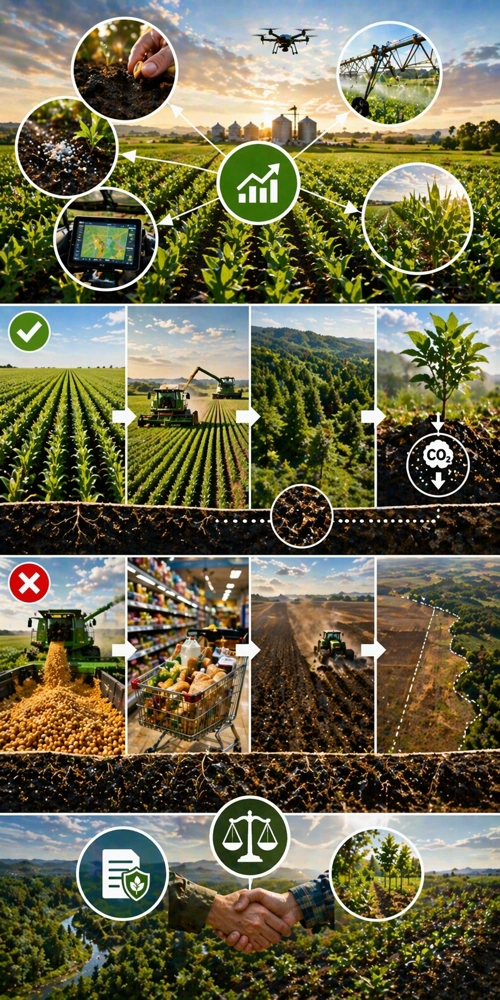
- Growing more food per hectare of land:
- Better seeds
- Fertilizer efficiency
- Precision agriculture
- Irrigation improvements
Mitigation per hectare
Two possible options:
In theory:
With higher yields, we will need less land for the same amount of food and will be able to set aside land for plant regrowth, which would lead to additional carbon absorption.
In practice (often):
Higher yields lead to cheaper food and more consumption. In this case, farmers expand anyway and do not reduce land use.
So yield improvements become major mitigation only if:
- They are combined with explicit land-sparing policies (protected areas, afforestation commitments).
Without this, mitigation per hectare is uncertain.
Mitigation per dollar
- Historically: extremely cost-effective for food security.
- For climate: cost-effective only if paired with strict land-use rules.
Co-benefits
- Food production capacity
- Potentially lower hunger levels
Limitation
- On its own, it does not guarantee climate benefits
- It can increase fertilizer use and N₂O if not managed
- It can lead to greater land conversion if demand keeps growing
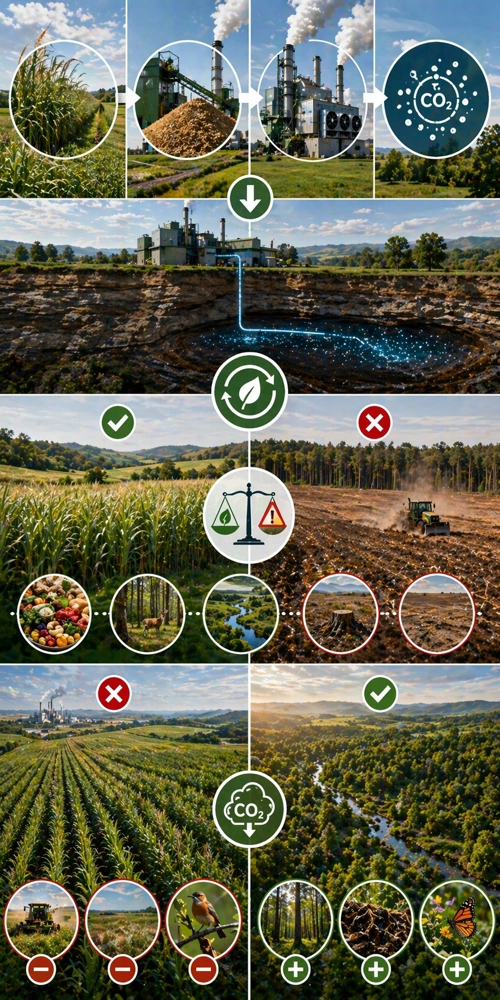
Method 5 – Bioenergy with carbon capture (BECCS)
What it is
- Growing biomass (crops, trees)
- Burning it for energy
- Capturing and storing the CO₂
On paper, this creates “negative emissions” because plants absorb CO₂ while they grow.
Mitigation per hectare
- Theoretically high – one of the leading negative-emissions options in many 1.5/2 °C models.
But, of course, not everything is so rosy:
- It requires large areas of land for energy crops.
- If this land displaces forests, grasslands or food production, the net benefits shrink or become negative.
Compared with rewilding/restoration of the same land:
- BECCS strongly competes with food and biodiversity.
- Many studies now warn against relying on very large-scale BECCS because of land/biodiversity risks.
Mitigation per dollar
- Costs are lower than DAC, but not trivial:
- Usually estimated at $100–300 per ton of CO₂ (highly dependent on project and region).
- Also depends on:
- CCS infrastructure – carbon absorption technologies
- Energy prices
- Policy subsidies
Co-benefits
- Some renewable energy production
- Potential rural income, if well designed
Limitation
- Very high land requirement
- Major biodiversity risk if scaled poorly
- Governance challenge (who gets the land? Not only in Bulgaria does everyone love a nice little concession)
You can read the continuation in the next article.
Sources:
https://www.nature.com/articles/s41467-023-41837-y
https://ourworldindata.org/environmental-impacts-of-food
https://ourworldindata.org/food-choice-vs-eating-local
https://www.science.org/doi/10.1126/science.aaq0216
https://www.oecd.org/content/dam/oecd/en/publications/reports/2022/09/meat-protein-alternatives_54e42940/387d30cf-en.pdf
https://www.nature.com/articles/s41467-023-41407-6
https://www.nature.com/articles/s41467-023-41407-6.pdf
https://pubmed.ncbi.nlm.nih.gov/39242882/