If you do not feel like reading the whole article, remember this:
- Transport is among the most stressful stages
- Overcrowding causes injuries and exhaustion
- Heat and cold increase suffering
- Rough handling increases fear and pain
- Birds are especially vulnerable during transport
- Many animals die before reaching the slaughterhouse
- Slaughterhouses are a critical welfare point
- Stunning often fails
- Some animals remain conscious during slaughter
- High speed increases the risk of mistakes
- The final hours often involve acute suffering
- Better standards can help only partially
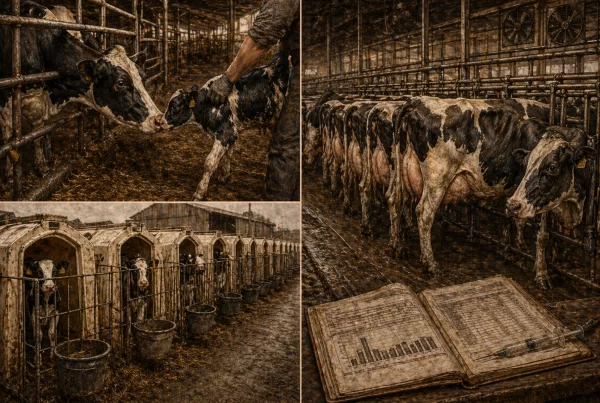
For farm animals raised in industrial systems, the final stage of life is often among the most stressful. Not that the other stages are exactly a song and dance, but here the horror becomes even greater. Transport and slaughter expose animals to unfamiliar surroundings, rough handling, overcrowding, hunger, thirst, temperature extremes, intense fear and, finally, death.
According to research summarized by the Humane Society of the United States, Compassion in World Farming and the international guidelines of the World Organisation for Animal Health, transport and slaughter are critical welfare points where animals may experience acute suffering if systems are poorly designed or poorly managed.
Understanding these final stages is essential for assessing the full welfare impact of modern animal agriculture.
Transport: A major animal welfare stressor
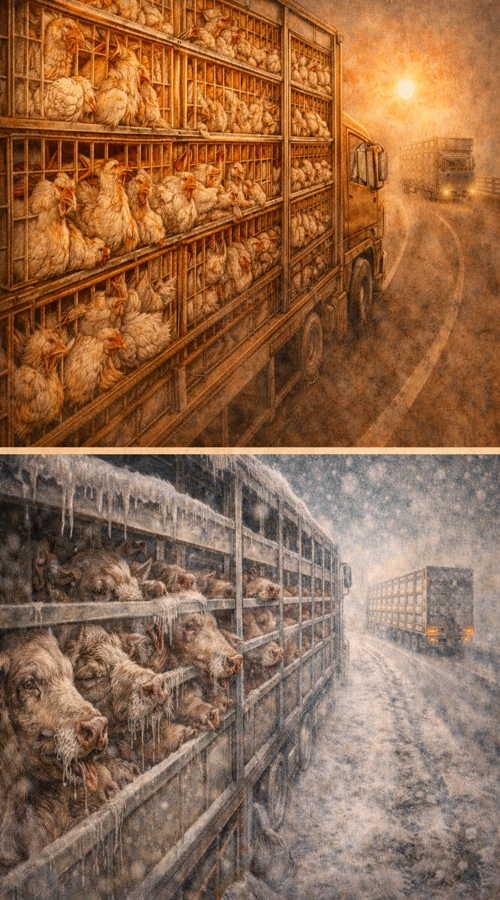
Animals raised for food are rarely slaughtered on the farms where they are reared. Instead, they are transported — sometimes over long distances — to centralized slaughterhouses.
Transport journeys vary greatly depending on region and infrastructure. In some cases:
- poultry may travel for several hours to processing plants
- pigs and cattle may be transported hundreds of kilometers
- animals may remain in trucks without food or water
Longer journeys increase the risk of fatigue, dehydration, injury and death.
Overcrowding
Transport trucks are often loaded with large numbers of animals in order to reduce costs. Overcrowding can lead to:
- injuries from trampling
- suffocation
- difficulty maintaining balance while the vehicle is moving
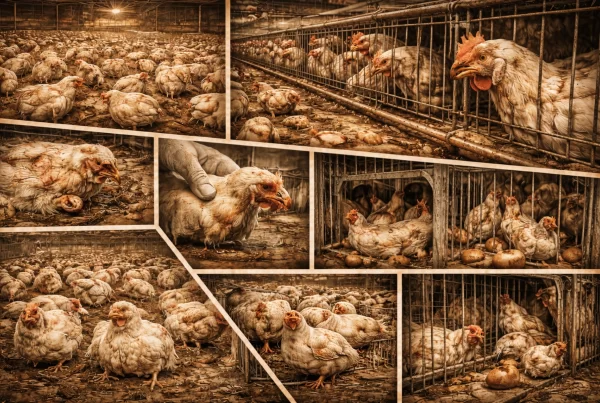
For poultry, transport crates may contain multiple birds with very limited room to move.
Environmental stress during transport
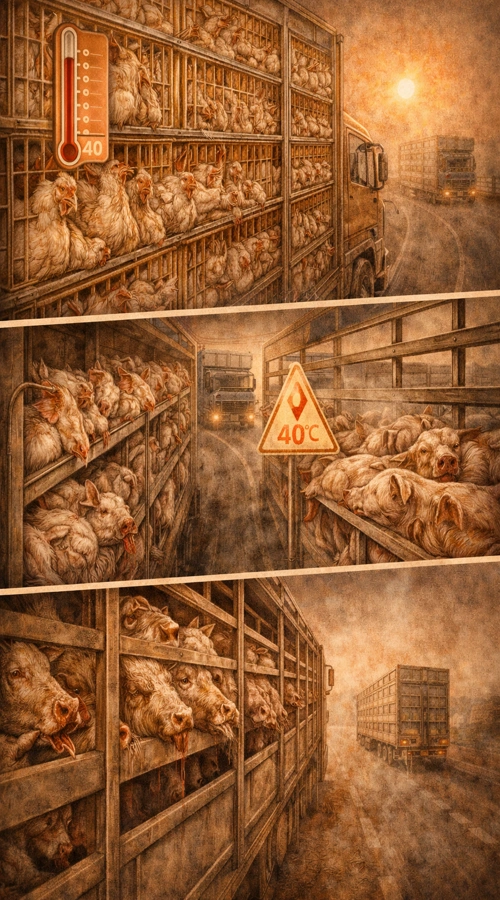
Animals are highly sensitive to environmental conditions, and transport exposes them to extreme weather.
Heat stress
In hot weather, animals may suffer from:
- dehydration
- overheating
- increased mortality during transport
Birds are especially vulnerable to suffocation because their transport crates provide limited airflow.
Cold stress
During winter transport, animals may face:
- low temperatures
- wind exposure
- hypothermia
Both heat and cold stress can cause suffering and death before animals even reach the slaughterhouse.
Handling and loading
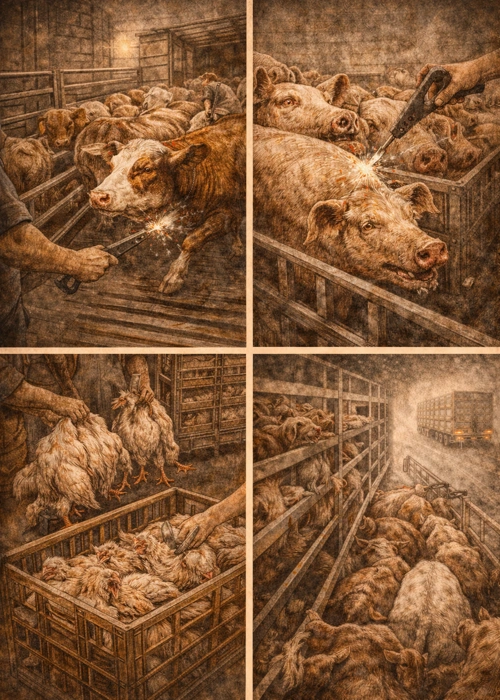
Before transport begins, animals must be moved from farms into trucks. Handling practices can strongly affect stress levels.
Common welfare problems include:
- use of electric prods on cattle and pigs
- shouting or rapid movement by handlers
- slippery loading ramps causing falls
- overcrowding in holding areas
Animals unfamiliar with ramps, noise or vehicles may resist movement, leading to additional stress and injuries.
Scientific studies show that heart rate, cortisol levels and other stress indicators rise sharply during handling and loading.
Transporting birds: Unique animal welfare challenges
Transporting birds presents several distinct welfare problems.
Catching and crating
Broiler chickens are usually caught manually by workers who gather the birds and place them in transport crates. During this process:
- birds may be grabbed by the legs or wings
- wings may be broken during handling
- birds may be dropped or crushed
Large facilities may move tens of thousands of birds in one night, increasing the risk of injuries.
Dead on arrival
A small percentage of birds die during transport due to:
- stress
- overheating
- crushing
- respiratory problems
Although the percentages may appear small, the enormous scale of poultry production means that millions of birds may die during transport each year.
Arrival at the slaughterhouse
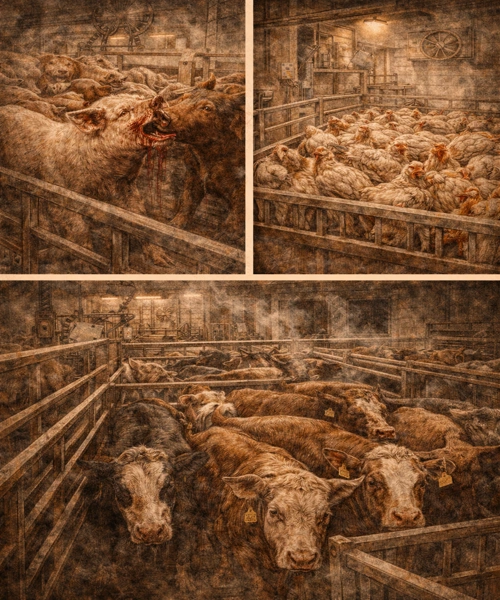
When animals arrive at the slaughterhouse, they are usually placed in holding areas known as lairage pens. These areas allow animals to rest before slaughter — how humane — but they can also cause additional stress.
Factors affecting welfare include:
- mixing animals from different groups, which can lead to fighting
- loud machinery noise
- unfamiliar smells and surroundings
- waiting time before slaughter
Animals may remain in lairage for several hours before processing.
Stunning methods
Before slaughter, animals are usually stunned in order to render them unconscious. Stunning methods vary by species.
Cattle
Cattle are usually stunned using captive-bolt guns, which penetrate the skull and disrupt brain function.
When performed correctly, this method can cause rapid loss of consciousness. However, errors may occur if:
- equipment is poorly maintained
- positioning is incorrect
- animals move suddenly
Incorrect stunning may require repeated attempts.
Pigs
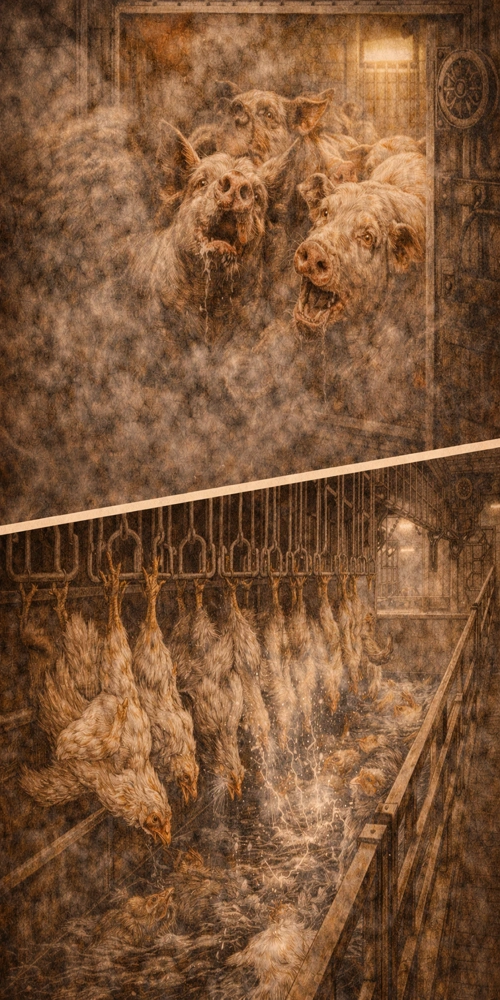
Many slaughterhouses use carbon dioxide (CO₂) stunning for pigs. In this system, pigs enter a chamber where CO₂ concentrations rise rapidly.
Animal welfare scientists have raised concerns that pigs may experience:
- breathlessness
- fear
- distress before losing consciousness
Research into alternative methods that may reduce aversion is ongoing.
Birds
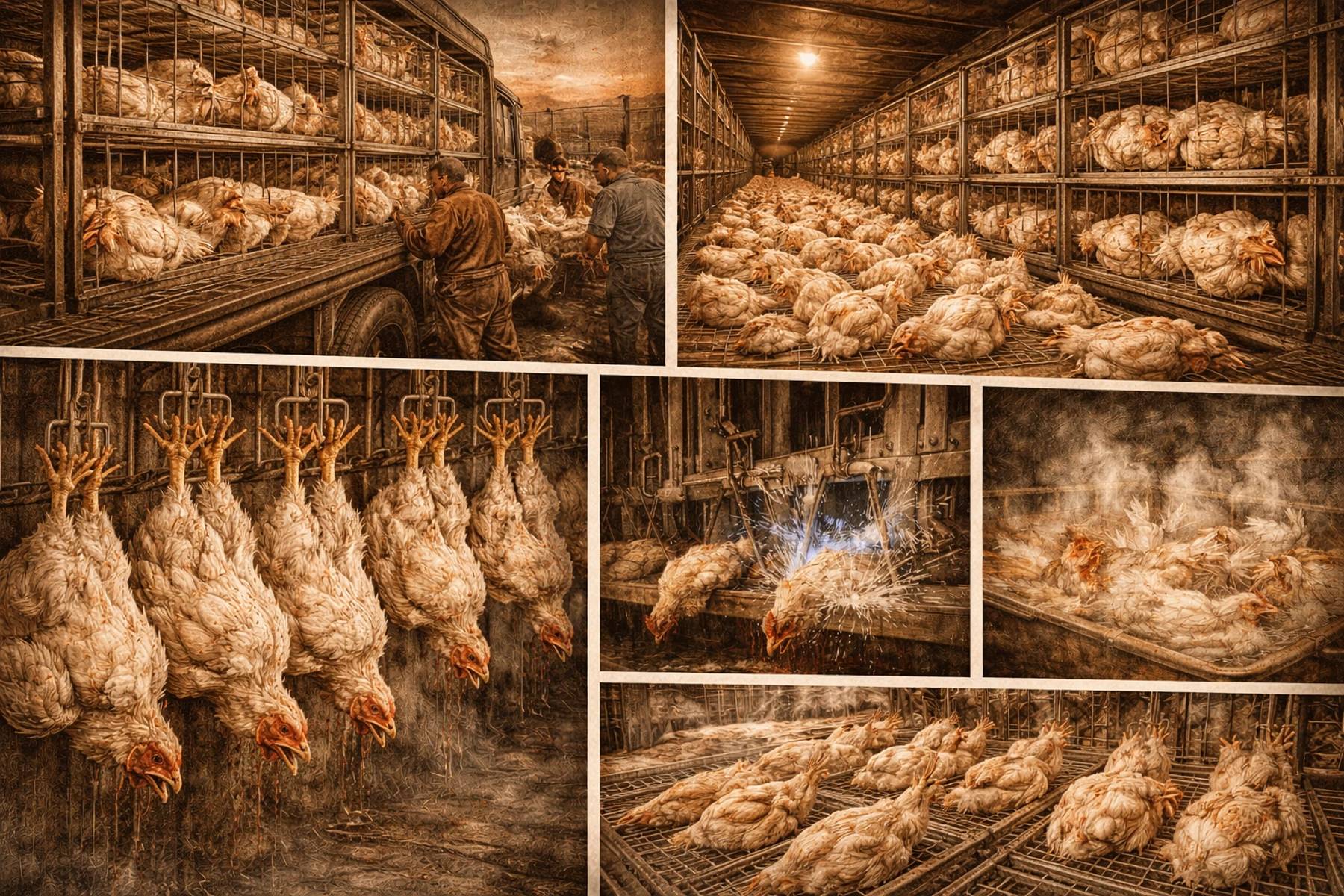
Birds are often stunned using electrical water-bath systems. Birds are hung upside down and their heads pass through electrified water.
Potential problems include:
- birds missing the water bath
- insufficient electrical current
- wing flapping causing misalignment
- when stunning fails, birds may remain conscious during slaughter.
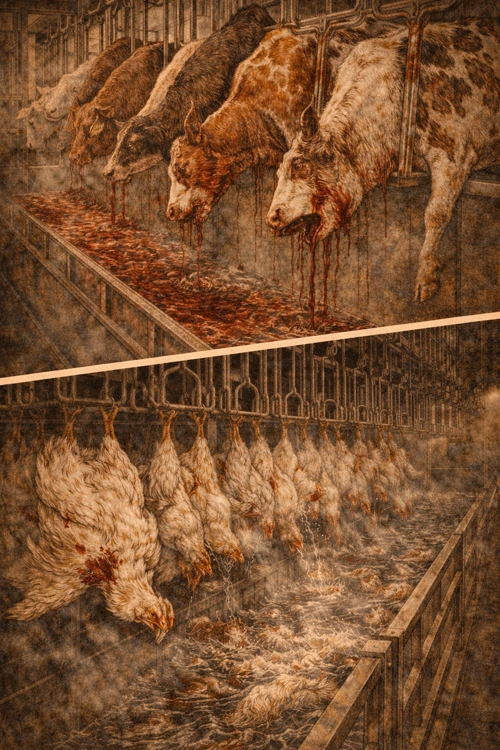
The slaughter process
After stunning, animals are killed by cutting major blood vessels in the neck.
In high-speed processing facilities:
- livestock slaughter lines may process hundreds of animals per hour
- poultry lines may process thousands of birds per hour
High processing speeds increase the risk of errors, such as incomplete stunning or improper cutting.
In poultry processing, birds pass through scalding tanks to loosen feathers before defeathering. If stunning or throat cutting fails, birds may enter these tanks while still conscious.
The HSUS report emphasizes that failed stunning can lead to birds being scalded alive, and there is no need to explain what level of pain that causes to an animal that has already suffered enough.
Why transport and slaughter are critical animal welfare points
Transport and slaughter are sometimes called “acute welfare stages” because they involve intense, but relatively short-term suffering.
Several factors make these stages especially difficult:
- animals face unfamiliar surroundings
- stress hormones rise dramatically
- animals experience physical exhaustion
- handling errors can have immediate consequences
For animals that have already experienced confinement or health problems on farms, the stress of transport can be even more severe.
Improving animal welfare during transport and slaughter
Animal welfare organizations and international guidelines suggest several improvements:
Transport improvements
- shorter journey times
- lower stocking density
- improved truck ventilation
- mandatory rest periods
- training for animal handlers
Slaughter improvements, however paradoxical that may sound
- better stunning technologies
- lower processing speeds
- improved equipment maintenance
- independent animal welfare audits
WOAH international guidelines emphasize that humane slaughter practices should minimize fear, pain and distress where possible.
Transport and slaughter represent the final stages in the lives of billions of animals raised in modern agriculture.
These stages expose animals to unfamiliar environments, physical stress and potential handling failures that can cause acute suffering.
Improving animal welfare during transport and slaughter requires better infrastructure, training and enforcement of humane standards. Although these improvements cannot remove all welfare problems linked to animal farming — or to its very existence — they can play a significant role in reducing suffering at the end of an animal’s life.
Sources:
https://www.humanesociety.org/sites/default/files/docs/hsus-report-animal-welfare-industrial-agriculture.pdf
https://www.woah.org/en/what-we-do/standards/codes-and-manuals/terrestrial-code-online-access/
https://www.woah.org/fileadmin/Home/eng/Health_standards/tahc/current/chapitre_aw_transport_land.pdf
https://www.woah.org/fileadmin/Home/eng/Health_standards/tahc/current/chapitre_aw_slaughter.pdf
https://www.ciwf.org.uk/research/
https://www.ciwf.org.uk/farm-animals/transport/
https://www.ciwf.org.uk/farm-animals/slaughter/
https://doi.org/10.1079/9781845932152.0000
https://www.efsa.europa.eu/en/efsajournal/pub/1966